
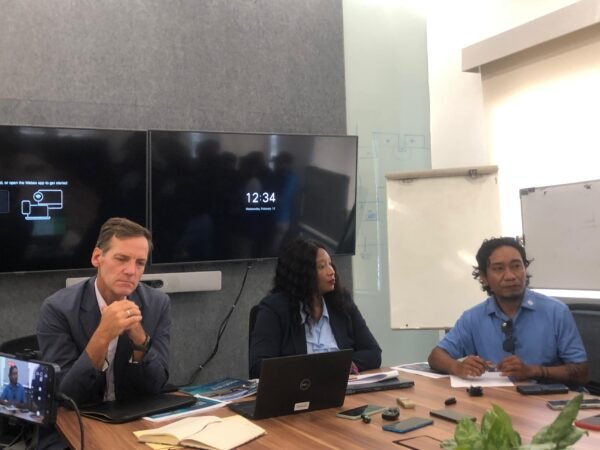
Dili, February 13, 2025 (Média Democracia) – The World Bank Timor-Leste held a press conference to deliver the second Timor-Leste economic report because the country’s finances are very crucial to the government and the entire population.
World Bank Timor-Leste Representative Bernard Harborne said that high government waste as a share of gross internal product (PIB) in Timor-Leste and modest returns on investments from its Petroleum Fund could impact the country’s tax institutions in the long term, according to a new World Bank report.
Timor-Leste World Bank President Bernard Harborne continued, “The Timor-Leste Economic Report Turning Public Waste into High Growth’, identifies that public spending averaged 85% of the PIB between 2013 and 2023 and that the PIB continued to grow at an average of 1.3% per year. During the same period, 42% of the population lived below the national poverty line.”
He continued that Timor-Leste is at a important moment for job creation and growth, the country is receiving encouragement to improve waste efficiency and diversify its economy.
“With proper tax reform, as the government is doing, the country can transition from big and small waste to strategic investments that drive growth to reduce poverty in Timor-Leste and secure our future,” he added.
He added that the report underlines the importance of ensuring the long-term sustainability of the Petroleum Fund, which continues to be the foundation for Timor-Leste’s tax stability. Building on the ASEAN accession text and recently enacted laws, such as the law on public financial management and provision, the government needs to clarify its reform schedule.
“Increased cost efficiency will reduce inefficient waste by reducing low-impact programs and shifting resources from recurring costs, such as salaries and subsidies, to high-impact sectors such as infrastructure, education and health,” he said.
He stressed, strengthen tax sustainability over the long term to comply with the rules of sustainable revenue estimation to preserve the Oil fund and diversify current revenue through increased tax collection.
“Improving Public Financial Management, Re-rationalizing the provision process, strengthening public investment management, reducing project delays and implementing program-based financial plans to ensure spending is in line with measurable results.” He added.
The report underlines the need to invest in infrastructure, human resources and agricultural productivity, while addressing inefficiencies in public spending to safeguard Timor-Leste’s tax health and build a resilient and inclusive economy.
To further explain that the World Bank asked the Timor-Leste government to strengthen the management of tax sustainability in the future in order to realize and utilize non-oil revenue costs of 12% for sustainability in the long term so as to reduce dependence on oil funds.
Reported by : Nelfiano
Picture by : Nelfiano