
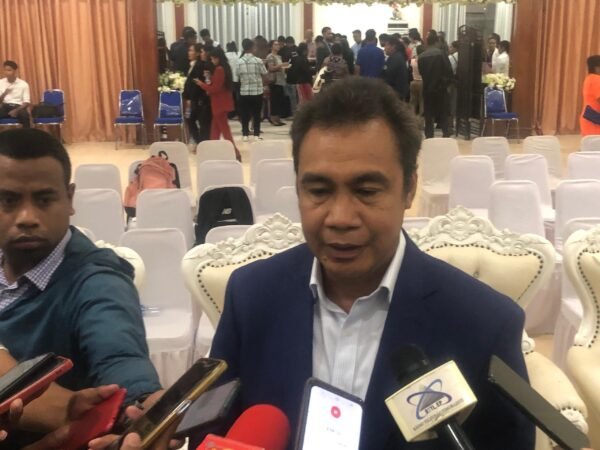
Dili, April 30, 2025 (Média Democracia) – Yesterday, April 29, 2025, Deolindo dos Santos’ term as President of the Court of Appeal officially ended, but he continues to serve while waiting for the President of the Republic (PR) to appoint new leadership in Timor-Leste.
The President of the Court of Appeal (PTR), Deolindo dos Santos, stated that work in this institution cannot simply be halted, which is why the National Parliament enacted a law to ensure the institution continues to operate seamlessly.
“The organic law states that the President of the Supreme Court of Justice will continue to exercise duties until the new President takes office. This means my term officially ends today, April 29, but since the President of the Republic has not yet appointed a new President of the Court of Appeal, I will continue my duties until the new President, appointed by the Head of State is sworn in. Only then will my duties officially end,” said Deolindo dos Santos.
He further urged the public and people of Timor-Leste to follow the Constitution in electing the President of the Court of Appeal, who also serves as the President of the Supreme Court of Justice and the Court of Auditors, under the authority of the Head of State.
“Regarding any candidates, the Judicial Magistracy Superior Council can make a recommendation to the President of the Republic. But I’m addressing the public to say that, according to the Constitution, the President of the Court of Appeal will automatically exercise the functions of the President of the Supreme Court of Justice and the Court of Auditors. We all know the Constitution clearly defines the Head of State’s competence in this matter, and the organic law confirms that this responsibility lies solely with the President of the Republic,” he said.
He emphasized that there is no need for any proposal from the Judicial Magistracy Superior Council, nor from the Government or National Parliament, because this is solely within the authority of the President of the Republic.
“The President of the Republic may choose to hear the Judicial Magistracy Superior Council, the Government, the National Parliament, and even civil society, but that is out of goodwill not because of any constitutional or legal obligation,” he reiterated.
He also reaffirmed that he will wait until the President of the Republic decides whether or not to listen to such input, as it is not a constitutional or legal requirement.
“My message to the public is that I do not want to anticipate anything, because I can still perform my duties properly. I saw publications today saying that my mandate ends today, and that’s true. My first term began on the 28th and my second term began on April 29, so my term ends today,” he confirmed.
He informed the public about the various tasks carried out in this important institution, which in the future may contribute to the incoming President once the President of the Republic appoints a new President of the Court of Appeal.
Further explained that any amendments to the Judicial Organization Law fall under the competence of the Government and the National Parliament. Therefore, he emphasized that the Constitution clearly defines the respective powers of the President of the Republic, the Government, the National Parliament, and the Court of Appeal. However, regarding changes to the Judicial Organization Law, such amendments can only be made through the authority of the Government and the National Parliament.
Reporter: Nelfiano
Photo: Nelfiano