
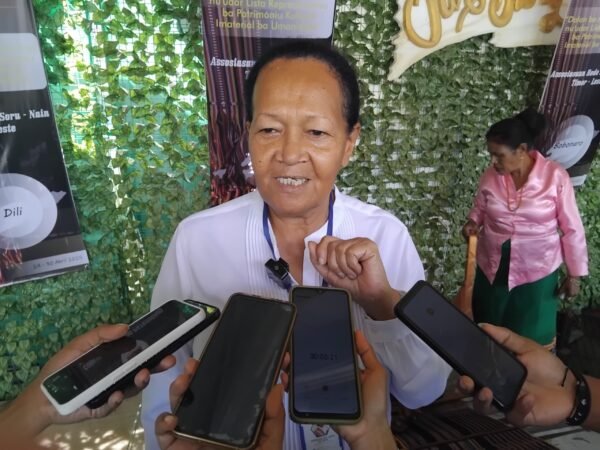
Díli, May 3, 2025 (Média Democracia) – Next year, the Government of Timor-Leste together with Timor Aid will build a museum in RAEOA (Special Administrative Region of Oecusse-Ambeno) to preserve Timorese Tais and other traditional materials so they will not be lost.
The Director of Timor Aid, Maria do Céu Lopes, stated that Timor Aid’s ultimate objective is to build a Tais museum in Oecusse in cooperation with the RAEOA government. In RAEOA, Timor Aid obtained a large area of land about five hectares, so they plan to build the museum there, enabling them to collect Tais from each municipality in Timor.
“This museum is not just a building to store Tais, no. Timor Aid also plans to use part of the land to plant cotton. We also aim to create a Tais ecosystem in RAEOA. This means not only producing the materials for Tais, but also collecting them and involving other related activities like handicrafts, all within the museum area,” said Maria do Céu Lopes.
She further explained that the museum is being built in Oecusse because in Dili, there is no available land. Timor Aid has requested land from communities and the government in Dili, but no land has been allocated. Therefore, they turned to Oecusse, where they were granted land and made the decision to establish the museum there.
“When the museum is built, Timor Aid will first bring in the Tais it already has around 40 pieces. We can say these are traditional Tais of good quality, though not the best, but still of a good category. The Tais of the highest category are currently stored in museums abroad. However, Timor Aid plans to make photographic copies of those Tais stored overseas, so they can be brought back and given to the Timorese owners who originally donated them, allowing the originals to be returned while their copies are displayed at the Tais museum in RAEOA,” she said.
She emphasized that Timor Aid is currently running a program involving a project to create video documentation of uma lulik (sacred houses) in various municipalities. For each existing uma lulik, Timor Aid will request permission to carry out video documentation based on their traditional rituals, such as animal sacrifices involving pigs, buffaloes, and other animals, to capture images of their blood, fat, and other elements. The documentation will also include traditional tais and other cultural objects that may still be preserved by the guardians of the sacred houses to this day.
“This documentation project is already underway, and Timor Aid members are carrying it out. Next year, Timor Aid will organize an exhibition at the Presidential Palace to present the results of the video documentation that has been conducted across municipalities,” the Director added.
She stated that regarding the construction budget of the museum, Timor Aid does not know the total cost, as the design is being handled by the government. According to the Memorandum of Understanding (MoU) that has been signed, the total budget is not specified within the agreement. Timor Aid’s role is solely to collect and bring traditional materials, especially tais, to be stored in the planned Tais Museum, so that high-quality traditional tais, like the ones previously mentioned, will not be lost.
“This museum is being built to store tais, but not all tais will be collected. Only the tais that Timor Aid has obtained through exhibitions such as one held in the municipality of Covalima will be brought. Timor Aid identifies old tais still in existence and makes agreements to bring them in for preservation in the Tais Museum,” she said.
She further explained that the museum being built by Timor Aid will initially house 400 tais. These are tais that Timor Aid has already named—considered old or traditional pieces from past generations. Timor Aid will also reach out to tais owners to ask if they are willing to donate their tais to be stored in the museum. The owners must provide their tais voluntarily and have their names recorded. Then, Timor Aid will visit their homes to verify whether the tais come from private individuals or groups, and will record the names along with the municipality of origin. Whether made personally or inherited from ancestors or elders, the tais will be cataloged and stored in the museum.
Report by: Domingas
Photo by: Domingas