
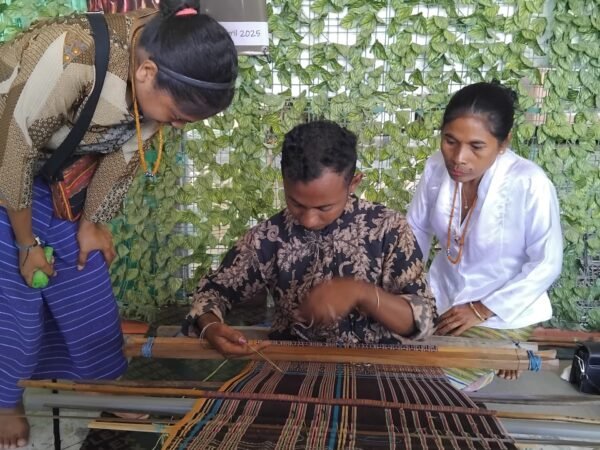
Dili, May 3, 2025 (Média Democracia) – Romario, from Covalima Municipality, Suai Administrative Post, is a transgender individual who has been working as a tais weaver. He began weaving twelve years ago and has since become the leader of a local weaving group known as Makerek Badaen in Suai.
As the head of Makerek Badaek group, Romario shared that he started learning how to weave tais twelve years ago while still in pre-secondary school. He learned from his mother and grandmother, who practiced daily activities at home such as spinning thread, dyeing tais, and weaving. By observing them every day, he gradually learned the skills himself.
“I really enjoyed learning how to weave tais, so every day I would just watch my mother and grandmother weave. At that time, I began seeking out female friends to join me because I identify as transgender, and together with these friends we began informally learning how to weave. At first, we learned to spin the thread and model it into the patterns of tais. We kept practicing daily until we mastered it, and only then were we instructed by our elders on how to dye the threads and weave them into tais,” said Romario, head of Makerek Badaek group.
He explained that the tais he weaves today originates from traditions passed down by his ancestors. Coming from a humble farming family, where his parents and grandparents were also weavers, Romario said his passion for weaving tais began at an early age as he watched them work every day.
“While learning how to spin and weave with my female friends, I eventually became proud of myself even as a transgender person because I never gave up on learning. Now, I serve as the group leader and represent my fellow weavers here in promoting Covalima’s name and teaching young girls how to weave,” he added.
Romario stated that the tais woven by their group features unique designs and colors that set them apart, which also affects their prices. For instance, due to the rising cost of thread, a men’s tais can sell for over $200 depending on the colors and motifs. Meanwhile, women’s tais generally range between $100 and $160, depending on material costs, which can also drive prices up.
“Weaving a woman’s tais takes a minimum of two weeks if done daily, but if we have other work and can’t focus, it might take up to a month. The money we earn from selling tais is partly saved, partly used to buy new thread, and the rest we divide among ourselves since we work as a group,” he explained.
He added that in the past, their woven tais had no market, so they only sold them locally within Covalima Municipality. But now, with support from the government and NGOs, their tais can reach Dili Municipality for sale. Currently, they have access to the tais market, where they display their tais, and clients purchase them directly from there.
Reported by: Domingas
Photo: Domingas