
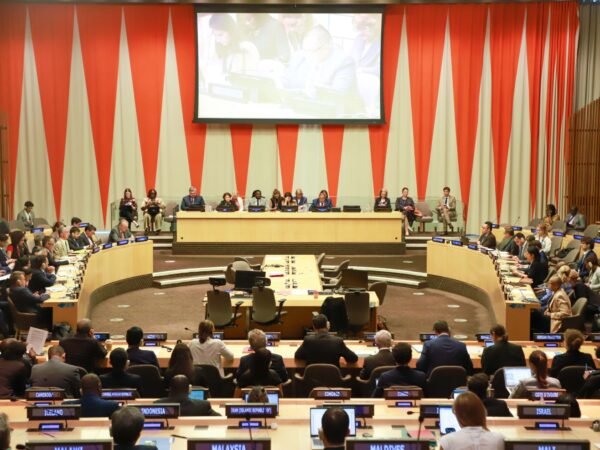
Dili, June 23, 2025 (Média Democracia) – Timor-Leste proudly shares its thoughts and experiences on poverty, underdevelopment, and conflict, particularly the implications for international peace and security. This knowledge-sharing event was held in New York, as reported by Media Democracia through information accessed via WhatsApp from the Media Officer of the Ministry of Foreign Affairs and Cooperation.
Timor-Leste’s position was presented by the Minister of Foreign Affairs and Cooperation, Bendito dos Santos Freitas, at the United Nations Security Council (UNSC) meeting chaired by the Minister of Foreign Affairs of Guyana, as President of the UNSC, opened by UN Secretary-General António Guterres.
In New York, accompanied by Timor-Leste’s Permanent Mission to the UN Representative, Ambassador Dionísio Babo Soares, Minister Bendito dos Santos Freitas participated in the UNSC open debate on “Poverty, Underdevelopment, and Conflict: Implications for Peacekeeping and International Security.”
The Minister emphasized that poverty and underdevelopment are not merely social conditions but act as catalysts for instability, particularly in fragile states where tensions escalate both within and between communities.
“Lack of access to basic services, high unemployment rates, and severe marginalization create deep grievances that can quickly lead to violent confrontations, disrupt peace agreements, and perpetuate cycles of instability. Moreover, weak institutions often struggle to provide governance, security, and impartial justice, thereby transforming poverty and underdevelopment into symptoms and main drivers of conflict,” stated Minister Bendito dos Santos Freitas.
As a member of the g7+ group of fragile and conflict-affected states, Timor-Leste has direct experience with how socioeconomic vulnerability shapes peace building efforts.
“Our shared reflections today directly address fragility and progress. Following the restoration of independence in 2002, Timor-Leste faced devastated infrastructure, fragile institutions, and widespread socioeconomic exclusion. This dire situation prompted us to fundamentally rethink our national development path in close collaboration with our international partners,” explained the Minister.
He further underlined that, with sustained support from international partners, inclusive policies, and initiatives to reduce poverty, Timor-Leste has achieved measurable progress through community-oriented development programs and strategic investments in rural infrastructure. The national poverty rate significantly dropped from 50.4% in 2007 to 41.8% in 2014, although significant challenges remain.
To diversify the economy, the government established the Petroleum Fund in 2002. This fund has allowed substantial investments in various sectors, including agriculture, small and medium enterprises, and emerging tourism. The Petroleum Fund also enabled dramatic expansion of electricity coverage, from a single-digit percentage at independence to 97% nationwide, alongside a remarkable increase in life expectancy from 57 years to 70 years within two decades.
Critically, all development and peace building programs are integrated into the government’s annual planning cycle and aligned meticulously with the 2011–2030 Strategic Development Plan, which sets clear indicators and objectives aimed at achieving middle-income status by 2030.
The government remains committed to strengthening public financial management and anti-corruption frameworks to enhance transparency and accountability in resource allocation.
In conclusion, the Minister stressed that peace is more than the mere absence of violence, it requires conditions that uphold human dignity, offer genuine opportunities, and foster hope. Timor-Leste reaffirms its strong commitment to this unified agenda and calls on all partners to intensify cooperation and shared responsibility to build a more just, peaceful, and prosperous world.
Report: Domingas
Photo: Media Officer, Ministry of Foreign Affairs and Cooperation TL