
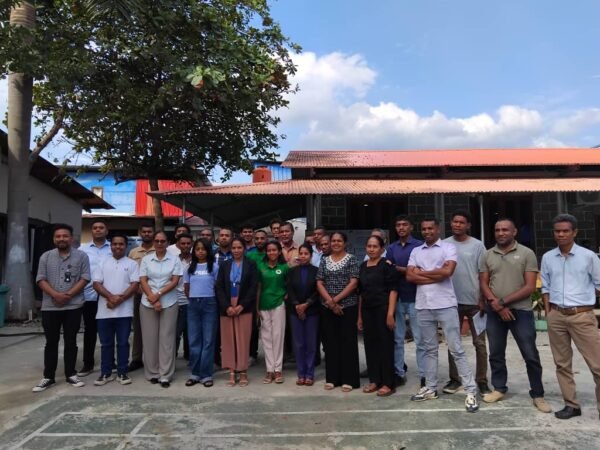
Dili, June 27, 2025 (Média Democracia) – The Core Group Transparency Timor-Leste (CGTL), in partnership with Oxfam in Timor-Leste, collaborated with the National Authority for Environmental Licensing (ANLA) and the National Directorate for Climate Change to analyze information gathered from Local Authorities in 10 villages across 4 municipalities: Aileu (Seloi Malere, Aisirimou), Ermera (Lauala, Talimoro), Liquica (Lauhata, Maumeta), and Dili (Motael, Bairo Pite, Comoro, Becora), regarding the impacts of climate change on vulnerable populations. This meeting took place at the HAK Foundation hall in Farol, on Thursday.
In an interview, Jemicarter Monis dos Reis, Coordinator of the Core Group Transparency Timor-Leste, explained that the main objective of this activity was to engage relevant stakeholders such as ANLA and the National Climate Change Directorate to share their perspectives on environmental licensing and the changes brought by climate change. The presence of representatives from the four municipalities was also significant.
“Another objective is to discuss what our Local Authorities are experiencing in their respective villages and regions. They can come together to share and reflect collectively, especially concerning climate change, so we can undertake actions to prepare for the future,” said Jemicarter Monis dos Reis.
Through this meeting, Local Authorities’ opinions were heard, and follow-up actions will be taken based on the issues each authority is facing. An introduction was also made about establishing a climate platform to serve as an intermediary bridge between villages, CCT (Core Group), and relevant stakeholders to address climate change and climate financing issues in Timor-Leste.
“In terms of climate financing, Timor-Leste has already received a total of 92 million USD since 2008. This platform aims to oversee and manage such funding. It is crucial to determine whether the funds have truly benefited our communities. We know that some countries and agencies have provided financial support, so we continue monitoring these funds,” added Jemicarter Monis dos Reis.
He also emphasized that climate change is not affecting only Timor-Leste but other nations as well, including major countries currently at war. The use of weapons and bombings contributes to climate change.
“We are continuously observing the situations in other countries, and their impacts are significant, not just on animals and nature but also on people. This meeting helps us reflect and prepare ourselves. Although Timor-Leste’s contribution to global emissions is very small only 0.03% compared to other countries that contribute up to 48%, we still need to know what actions we can take to reduce emissions and avoid negative impacts on nature and our people,” explained the CGTL Coordinator.
He further mentioned the damages caused by climate change, such as the severe flooding in recent years that destroyed the environment and people’s belongings in urban areas. Thus, the State of Timor-Leste has been making efforts to support affected citizens and monitor damage to crops caused by flooding.
Victor, a Local Authority from Maumeta, Bazartete Post, Liquica Municipality, stated that this activity is very important for community leaders in understanding and addressing climate change due to its major impact on people’s daily lives, especially for farming communities.
“Today’s meeting allowed us to come together and exchange thoughts. Community leaders discussed observations specific to each municipality and post. From this, we developed collective reflections on this issue,” said Victor.
He cited an example of environmental pollution, referring to the open-air landfill in Tibar, where trash is often burned in the late afternoon, releasing heavy pollution. “The smoke is extremely strong,” he said. This has a significant health impact on surrounding communities, especially children, as the burning garbage causes diseases like asthma. Burning waste should not be allowed, and he called for the state to find a better solution by promoting recycling.
“Burning trash should be banned, and the state must step in. Waste needs to be managed differently, possibly recycled instead of burned. Trash is being dumped indiscriminately, including organic and other waste, so the government must take a better approach. There should be plans and programs to manage waste because pollution doesn’t only affect communities in Tibar, it reaches other areas like Tasi-Tolu as well,” said Victor.
He reiterated that this issue must be addressed, especially concerning waste disposal, which includes burning plastics and other harmful materials. These problems require serious attention from relevant stakeholders. The state must develop programs or plans to process waste so it doesn’t need to be burned but instead can be transformed into something reusable.
Report: Domingas
Photo: Domingas