
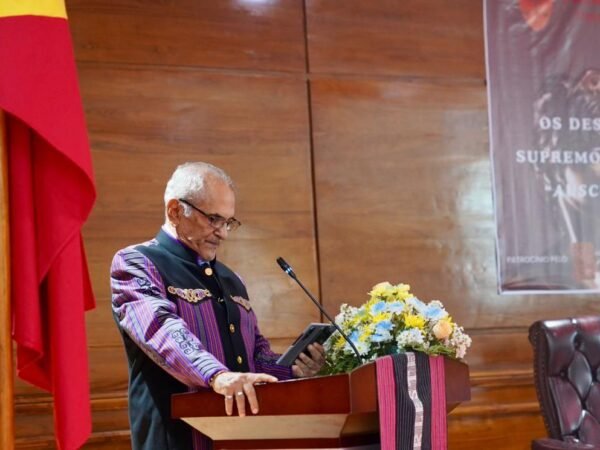
Dili, June 30, 2025 (Média Democracia) – The President of the Republic delivered a speech today, emphasizing that the establishment of the Supreme Court of Appeals will serve as a vital bridge for constitutional democracy, ensuring the rule of law prevails and justice remains accessible to all.
President José Ramos-Horta stated that today and in the months ahead, fundamental pillars of democracy will be reaffirmed through the creation of the Supreme Court of Justice. This is not merely an administrative act but a constitutional imperative that will strengthen the rule of law and complete the justice system’s vision enshrined in the Constitution.
“The United Nations Transitional Administration in East Timor (UNTAET) established a transitional judicial service in 2000, consisting of a small number of judges, prosecutors, and public defenders. On January 7, 2000, these pioneering judges were sworn in, marking the start of our judicial system’s gradual development into a fully national institution,” the President recounted.
He highlighted a key milestone on 21 June 2007 when Timor-Leste achieved full capacity in national judicial administration. Judges, prosecutors, and public defenders, trained at the Dili Legal Training Center, assumed their roles with pride. This transition marked the shift from international dependency to self-sufficiency in judicial affairs.
“The Court of Appeals already functions as a high court, handling both appellate jurisdiction and constitutional responsibilities. However, its role has underscored the urgent need for reform. The Constitutional mandate and contemporary challenges require the Supreme Court of Justice to become the nation’s apex court,” he said.
President Ramos-Horta asserted that the Supreme Court must become the final authority of the judiciary, a status not yet attained. Institutional tensions and ambiguities in authority stem from the lack of a constitutionally-defined Supreme Court.
“The constitutional lack of clarity around the Supreme Court has created ambiguity in our higher judicial authority, especially regarding constitutional interpretation and electoral disputes. Democratic legitimacy, judicial hierarchy, and public trust all hinge on having a higher court that not only executes justice but also visibly does so at the highest level,” he emphasized.
He expressed the need for a comprehensive revision of the judicial system—both in its structure and relevance to people’s lives. The system must continue to evolve with the changing circumstances, society, and communities of Timor-Leste.
“Simply replicating institutions from other societies without building on our own context often fails due to a lack of local competence or relevance. Any judicial system and its institutions must grow from our present situation, not just copy another society’s approach,” he stressed.
The President underscored the importance of integrating effective customary dispute-resolution mechanisms based in the suco (village) level with formal judicial procedures. Ensuring such integration is crucial so that all levels of society feel their constitutional rights are respected and applied fairly.
“An apolitical approach is essential to ensure public confidence that the judiciary is impartial, capable of making principled decisions, and respects the rule of law. For democratic balance, an independent judiciary acts as a check on the executive and legislative branches, guaranteeing that no part of government oversteps its constitutional authority,” he noted.
He reaffirmed the need to appoint only qualified judges. The Supreme Court must be composed of jurists with deep experience, specialized knowledge of constitutional law, and strong commitment to judicial independence.
“Esteemed guests, the creation of the Supreme Court of Justice is not just an institutional reform it represents fulfillment of our constitutional promise and culmination of democratic architecture. Justice is not only about resolving disputes or punishing wrongdoing—it ensures that all citizens, regardless of social status, can trust that the law protects them and their rights are respected,” he stated firmly.
He concluded by underlining that the establishment of the Supreme Court will safeguard the Constitution and protect democratic values. Today’s step is crucial to realizing the founding vision and consolidating democracy’s foundations. A functioning Supreme Court is indispensable to building a just and equitable society for all Timorese.
Furthermore, the establishment of the Supreme Court of Appeals advances with determination, wisdom, and unity, turning this constitutional imperative into reality for democracy, the Constitution, and a complete, effective judicial system led by the Supreme Court of Justice.
Report: Domingas
Photo: Media Officer PR