
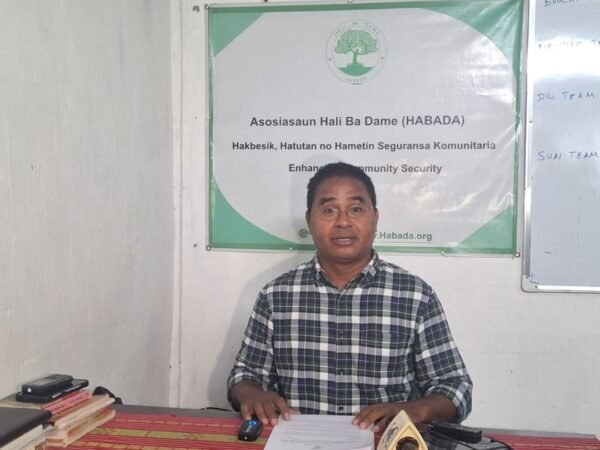
Dili, November 18, 2025 (Média Democracia) – The Non-Governmental Organization Hali ba Dame HABADA held a press conference regarding its submission to Parliamentary Committee B on the proposed State Budget Law (OJE) 2026 for the National Police of Timor-Leste (PNTL). The press conference took place at the HABADA office in Golgota, Dili.
HABADA’s Executive Director, Abel Amaral, stated that HABADA is a civil society organization dedicated in monitoring and advocating for community security and police governance in Timor-Leste.
“Today we released our detailed analysis of the 2026 State Budget proposal related to the National Police of Timor-Leste (PNTL). Based on official data, the analysis identifies positive points in transparency but also highlights critical structural imbalances that could undermine the police’s long-term operational effectiveness,” said Executive Director Abel Amaral.
According to him, the total proposed budget for PNTL in 2026 is US$49,511,296. Although this amount demonstrates the State’s commitment to the institution, its structure reveals significant vulnerabilities, with 88.2% of the total (US$43,695,119) allocated solely to salaries, while the remaining 11.8% covers operational needs and other investments.
“A modern police force cannot function merely as a ‘salary machine’; it is essential to ensure that PNTL has the necessary resources to operate effectively, including fuel, vehicle maintenance, specialized equipment, technology, and quality training. The current fiscal imbalance poses risks to the sustainability of police operations,” Amaral stressed.
He added that HABADA recognizes positive aspects in the budget proposal, including its clear and detailed structure, which facilitates effective monitoring of expenditures by unit and organizational program. The strong emphasis on Program 366 – National Security (US$46.2 million) reflects clear alignment with PNTL’s constitutional mandate.
“The inclusion of specific budget lines for ‘Minor Capital’ within special police units is also a positive sign of recognition of the need for investment in equipment,” he added.
HABADA’s analysis of the 2026 budget proposal also examined the 2025 budget execution (data up to 13 November), revealing concerning results.
“The overall execution rate of the PNTL 2025 budget stands at 78.8%, but the reality is far more troubling. Several critical units show extremely low execution rates — such as the Maritime Unit (69.2%), National Operational Command (66.6%), and Region II (57.4%), which clearly illustrates the problem,” Amaral stated.
These figures, he said, indicate deeper issues such as unrealistic planning, bureaucratic procurement processes, and weak management capacity. The direct consequences include reduced operational capability, fewer maritime, border, and national patrols, leaving the country vulnerable to illegal or criminal activities.
Based on this analysis, HABADA presented several urgent recommendations to the competent authorities, including the National Parliament and Government, which are currently discussing the specialized phase of the 2026 PNTL budget approval.
He explained that revising the overall financial framework should consider increasing the total 2026 budget for PNTL, with a specific focus on increasing the absolute amount allocated to “Goods and Services” and “Capital Acquisition,” without affecting salaries. This would help achieve a more balanced percentage distribution without reducing wages.
“Regarding personnel allocation, while salaries must be maintained, it is essential to conduct a study to ensure that salary expenditures are applied efficiently and that the career and staffing structure is aligned with the actual needs of the police,” he added.
He emphasized that the 2026 results-based budget must strengthen the connection between funding and expected outcomes. Each program and activity must have clear, measurable objectives (e.g., reducing crime by X%, increasing border seizures by Y%). Budget allocations should be justified based on achieving these goals.
For units with weak performance in 2025 (Maritime, Regions II and III), the 2026 proposal must be accompanied by corrective action plans. These plans should identify the root causes of poor performance and establish clear goals for improvement.
He further noted that strengthening operational units, specifically the Maritime Unit, Border Patrol, and Special Units requires increased allocations due to their high operational costs and critical roles in national security. Investment in mobility, secure communications, and surveillance equipment must be prioritized.
“Creating a specific budget line for technological investment should also be considered, or strengthening existing lines, to support police technologies such as information systems, video surveillance, and forensic equipment, all of which are essential for a modern police force,” Amaral added.
He concluded that improving budget management capacity requires continuous training for PNTL managers, especially at decentralized unit levels, to enhance financial planning, execution, and reporting.
Amaral emphasized that the 2026 State Budget represents a critical opportunity to transform PNTL into a more agile, well-equipped force capable of responding to complex 21st-century security challenges. Addressing the identified imbalances while capitalizing on transparency improvements will contribute decisively to the efficient and effective allocation of resources, strengthening PNTL’s capacity to serve and protect the people of Timor-Leste. HABADA will continue to monitor the budget process and advocate for transparent, efficient, and community-focused public security management.
Report: Nelfiano
Photo: Nelfiano