
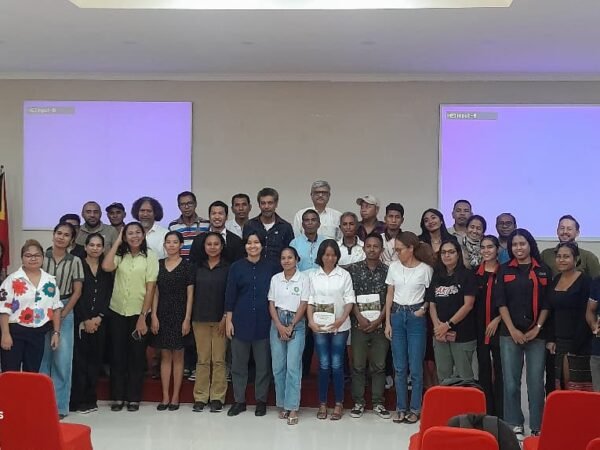
Dili, December 19, 2025 (Média Democracia) – Rede ba Rai, together with FONGTIL and other local NGOs, held the launch of a research report on women’s land ownership security within a patrilineal system. The event took place at the Tower Fatuha Hall in Dili on Thursday.
National Coordinator of Rede ba Rai, Pedrito Vieira, said the objective of launching the research was to conduct over two years in exploring ways to ensure women’s land rights and ownership in a patriarchal system that still exists across the country.
“This research aims to open public discussion and influence policymakers to give greater attention to women who play a vital role in this country. Many women continue to suffer due to insecure land use and lack of legal land ownership. The findings provide an important source of information related to existing constitutional and customary laws that should offer greater advantages to women, ensuring equal rights and justice, and supporting future development processes,” said Pedrito Vieira.
He explained that the research was conducted over two years in four municipalities such as Aileu, Lautem, Bobonaro, and Dili using a simplified approach due to limited resources.
“We all know that some cultures remain strongly patrilineal and are not yet open in valuing women’s rights. In municipalities such as Lautem, cultural traditions remain very strong. While some families treat daughters equally to sons, others still do not recognize women’s rights to land. Some families may allocate land to daughters, but change remains difficult due to the deeply rooted patriarchal system,” he added.
Pedrito Vieira emphasized that although cultural norms may gradually evolve, the government must take responsibility for protecting women’s land ownership rights. The research findings are intended to serve as a reference for government decision-making, particularly in advancing land justice for women in Timor-Leste.
He further noted that land issues remain significant within the national land registration system, where nearly 30% of women are registered in the land cadaster but ownership remains dominated by men. While joint land registration between husbands and wives is encouraged to ensure legal security, progress has been more visible in Dili. Rede ba Rai plans to continue similar research in other municipalities with different thematic focuses.
Meanwhile, FONGTIL Director Valentim da Costa stated that the research is highly important, as the Constitution guarantees equal rights for both women and men. However, women still face ongoing challenges in accessing land, particularly in relation to cultural inheritance practices.
“This research contributes significantly to promote change by enabling women’s access to land. Equality before the law must be upheld to eliminate discriminatory practices and ensure inclusive development, where everyone feels secure, protected, and respected,” said Valentim da Costa.
He added that the research findings are expected to assist the government in managing legal issues related to land disputes, preventing escalation and reducing the risk of violence arising from land conflicts.
“One of the main barriers remains patriarchal cultural beliefs, where men are perceived as having greater rights to land ownership, even though women share equal lineage through both maternal and paternal lines. Our system often leaves women without space to claim their cultural inheritance rights,” he explained.
Valentim da Costa further noted that the research can help improve the management of customary inheritance practices in a peaceful manner and promote unity, enabling equitable and dignified land governance that respects the rights of all citizens.
The launch of the research report on women’s land ownership security was organized by Rede ba Rai in collaboration with FONGTIL, with participation from local and international NGOs to advocate for women’s rights to land ownership.
Report: Nelfiano
Photo: Nelfiano