
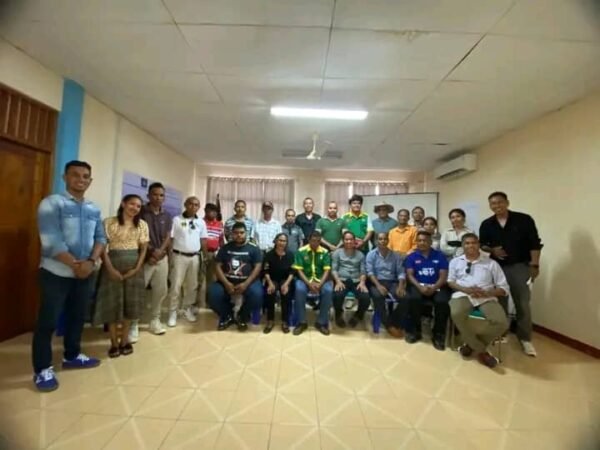
Dili, December 24, 2025 (Média Democracia) – JSMP Timor-Leste held a press communication with participants from political parties represented in the National Parliament, calling on the Civil Society Support Office (GASC) to continue its partnership with JSMP in facilitating training for political party structures down to the post and grassroots levels. The statement was accessed by Média Democracia from JSMP’s official page on Tuesday.
The Executive Director of JSMP, Ana Paula Marçal, said that the request was conveyed during a training session on “Transformative Leadership and Democracy in the National Parliament,” held on 17 December 2025 at the Democracy Hall of the National Electoral Commission (CNE) in Manatuto Municipality. The training focused on members and cadres of political party structures represented in the National Parliament, including CNRT, Fretilin, PD, PLP, and KHUNTO.
“JSMP feels pleased and honored to have the opportunity and trust from GASC to organize training focused on transformative leadership. The target participants were political party cadres at the grassroots level, and the GASC team accompanying this training directly witnessed the high level of enthusiasm shown by participants throughout the session,” said JSMP Executive Director Ana Paula Marçal.
She explained that during the training sessions, participants recognized that the topics of transformative leadership and democracy are relevant and important in Timor-Leste’s current context. Therefore, participants recommended that GASC provide adequate financial resources to allow JSMP to extend the duration of training and increase participation quotas for each political party.
“Municipal leaders from PLP and KHUNTO who participated in this training felt it was unfair that the number of participants accommodated was smaller compared to larger parties, as smaller parties need more support and deserve greater attention in activities such as this,” she added.
The Executive Director affirmed that participants viewed the topic of transformative leadership as a new and highly relevant theme for both the present and the future, at national, municipal, and grassroots levels. Through this theme, participants were encouraged to think critically and reflect on current leadership figures within their respective parties, independent leaders, and even themselves, enabling them to project personal plans to become future leaders. The subject was both challenging and inspiring, motivating participants to take on leadership responsibilities in the future.
“These party cadres are committed to disseminating this information to militants within their respective parties. However, if JSMP were able to reach the grassroots directly, it would be a privilege, and participants would be ready to mobilize cadres to take part. During the question-and-answer sessions, participants raised relevant concerns about minimal investment in the education sector and strongly questioned why education does not receive serious attention,” the Executive Director stated.
She further informed that participants also expressed curiosity and demanded clarification regarding current cases related to the appointment of leadership within judicial institutions, which have caused public confusion, particularly emphasizing that non-compliance with court decisions poses a real risk and threat to the existence of a democratic rule-of-law state. Therefore, they urged current leaders in power to demonstrate political maturity and willingness to assume responsibility by placing the interests of the State and the people above personal or partisan interests.
“Other participants also expressed concern over urgent legal amendments, political recruitment, and the placement of political party cadres in positions such as the Anti-Corruption Commission (CAC), which has resulted in independent institutions failing to function effectively and losing public trust,” she added.
The Executive Director explained that during the presentation sessions, JSMP delivered general material on transformative leadership and democracy in Timor-Leste. The materials addressed and elaborated on relevant basic concepts, including general notions of leadership, leadership theories and perspectives from experts, differences between a leader, manager, chief, boss, or patron, as well as types and styles of leadership.
“All of these materials were compiled into a manual distributed to participants and financed through civil society funds managed by the Civil Society Support Office (GASC),” said Executive Director Ana Paula Marçal.
She highlighted that a total of 20 participants took part in the activity, drawn from political parties represented in the National Parliament. These included CNRT with five (5) members, Fretilin with five (5), PD with four (4), PLP with three (3), and KHUNTO with three (3). The activity was directly accompanied by the GASC team.
She further explained that the activity was carried out through collaboration, partnership, and financial support from the Civil Society Support Office (GASC), the Office of the Vice Prime Minister for Social Affairs, the Ministry of Rural Development and Community Housing, the IX Constitutional Government, and with maximum support from the Director of the CNE Manatuto Municipality and all staff who provided the venue and relevant preparatory assistance.
Report: Nelfiano
Photo: Média JSMP