
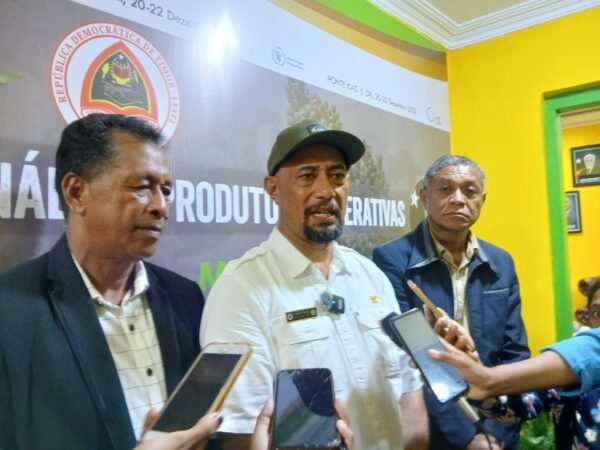
Dili, April 9, 2025 (Média Democracia) – The State Secretariat for Cooperatives (SECoop) has officially signed agreements with movements, associations, and foundations, totaling 76 beneficiaries, to receive allocations from the Public Transfer Fund.
Secretary of State for Cooperatives, Arsénio Perreira da Silva, stated that after the approval of the 2025 General State Budget and the issuance of the decree for its execution, SECoop immediately announced the process for beneficiaries to submit their proposals.
“Before this, we created a roadmap and formed a committee, which we named the Public Transfer Fund Commission, to start receiving proposals. Then we carried out verification at the municipal level, based on the directions provided,” Secretary Arsénio told journalists after signing the Memorandum of Understanding (MoU) at SECoop’s office on Tuesday.
Following the verification process, the team reviewed and evaluated the proposals. Based on their assessment, they made recommendations to SECoop, which led to the agreement signed today between SECoop and the selected beneficiaries.
The fund amounts provided to beneficiaries are not uniform. They depend on the proposals submitted to SECoop, and full funding is not guaranteed.
“Some proposed $1,000 to $10,000, but we don’t fund the full amount. We reduce it, partly to ensure beneficiaries contribute something themselves and feel a sense of ownership over the cooperative’s development,” he explained.
The reductions can be as much as 50% to 60%, depending on the logic and structure of the proposed budget. Some proposals exceeded $300,000–$400,000, while others were as low as $2,000. The amounts also vary depending on the number of members or the nature of the organization, group, or cooperative submitting the proposal.
The Secretary also mentioned that if there is still a balance left, a second round may be announced, allowing cooperatives that did not get a chance in the first round to submit proposals. This would follow the same process of announcement and verification, depending on the quality of new proposals.
He reported that 76 beneficiaries signed the MoU, from a total of 156 proposals submitted. However, not all were selected due to SECoop’s criteria and guidelines.
“In accordance with public service laws, we follow the required standards. That’s why we invited the Deputy Commissioner of CAC (Anti-Corruption Commission) and accepted their recommendations. In the future, I think PDHJ and other relevant institutions should also participate to ensure openness and transparency,” he said.
Deputy Commissioner for Cooperation Services, Miguel Acácio Faria, stated during his speech that the presence of the Anti-Corruption Commission (CAC) is a solution to ensure transparency and accountability in the use of public funds.
“In the context of the State Secretariat for Cooperatives, CAC plays a fundamental role in three areas: Education, Prevention, and Support. We are ready to support SECoop by organizing workshops for cooperatives to show how malpractice, such as favoritism or document falsification, can harm the people,” he added.
CAC supervision will monitor the fund allocation process to ensure that subsidies and public support are not given to individuals with personal ties to officials, but rather to those who truly meet the criteria.
In cases where there are signs of corruption, CAC will conduct thorough investigations and bring perpetrators to court to demonstrate that the law applies equally to everyone. CAC’s role is not to criminalize but to support the proper use of public funds.
The MoU serves as a contract to regulate fund management and reduce opportunities or risks of corruption.
“On this occasion, I want to ask beneficiaries to clearly outline their plans for using the funds whether to buy tractors, start plantations, or conduct training. This is to prevent funds from being wasted on unclear or ‘dead’ activities,” he emphasized.
Beneficiaries are also required to present quarterly reports with evidence such as photos or receipts to SECoop, to show that the money is being used responsibly, transparently, and in accordance with the original plan.
Among the beneficiaries is the Federation of Multi-Cooperatives from Viqueque. The federation’s president, Mariano Gomes, stated that this was their first time signing a MoU, and it felt different due to CAC’s presence, which reinforces the importance of following established procedures. The budget execution must be based on the group’s real needs and follow their original plans.
The federation consists of four cooperatives, including credit unions and production groups such as virgin coconut oil producers. The total amount granted to the federation is $7,000.
Reporter : Estefania
Photo : Estefania