
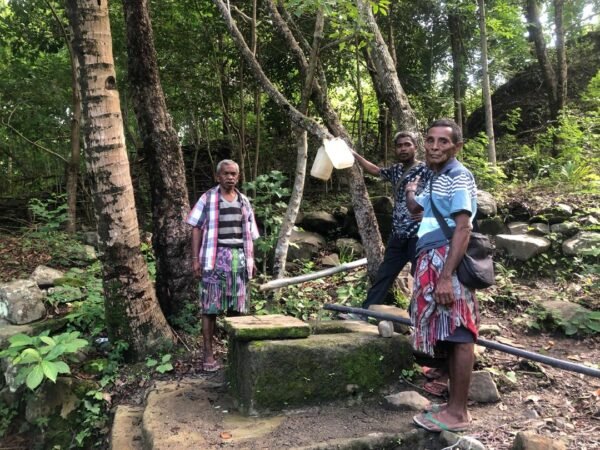
Oe-Cusse, January 30, 2025 (Média Democracia) – The Sustainable Youth Association (AFOS) has been collaborating with the Hoi-Neno community, Bobometo Village to provide material support and training on how to dig water and conserve water so that it can be used throughout the summer.
Hoi-neno community member, Domingos Meta, said that AFOS has been teaching how to plant springs and store water from dug wells so that the springs do not dry up during the summer because previously the springs were always scarce and dry during the summer, which had an impact on the community.
“We are experiencing obstacles such as channels to channel water to meet daily needs because so far many channels have broken and been damaged, so we can’t channel it anymore because we don’t have the key. We made a plan that each family must collect funds of 1 USD to 2 USD and above to buy a new channel so that it can be distributed to the entire community.” He said.
He continued, until now there is no longer a water shortage because every year the Hoi-neno community always works together to plant trees near the Lopes spring because previously the spring had dried up due to a lack of trees.
“We also ask the government to pay attention to us to repair the channels because so far we have bought the channels at our own expense, but if in the future the channels are damaged again we cannot afford to buy them again, therefore we ask the government to pay attention to the problems we face in these remote areas.” He said.
He added that so far AFOS is the only one that has provided material assistance to help the Hoi-neno community regarding water problems. Previously, the community had come to the base but that was not enough because AFOS only provided assistance as much as they could and the water that was available had not yet reached the entire community and some lived far from the place.
“We recently talked to AFOS to conserve one more spring, but AFOS said in the future they will support some materials, but now they support as much as they can, so if we ask for what they have, they always support, but for what they don’t have, they can’t support.” He added.
He emphasized that the name of the Lopes spring comes from the time of their ancestors who every year always held traditional ceremonies such as bringing sacrificial animals such as cows and pigs, while for goats they only brought these animals during the dry season to ask permission from nature so that the spring would not dry up.
“So far, AFOS has provided plants with 100 to 1000 types such as ketapang trees, oenini and others. Every year, we always bring these trees to be planted near springs such as lopes, oeteka, putu and taekmanos.” He said.
The benefits obtained from AFOS are providing training on how to dig wells in the village, so that the springs are large and strong to be shared with the community, because they themselves have not made wells, but they, together with AFOS, dig water so that the wells have started to get big until now.
As the Director of AFOS, Francisco Cato said that AFOS intervened in Bobometo Village, which consists of six sub-villages, by introducing the hambrik and diarrhea programs in the iluminu action activities on how to provide training to the community, especially in preserving land, including preserving rainwater to grow springs.
“Previously, the community’s water discharge was lacking, so in the first year we conducted an assessment with the community to prepare a water discharge activity plan to increase water, so we had to take water from digging a 2×2 or 5×5 hole in the spring so that when it rains it can seep into the spring.” said the Director of AFOS
He continued, during the teaching activities they also dug water tubes at the top of the mountain based on the length and width of 5 meters, if it was less than 5 meters it was said to be only for drawing water.
“Related to development activities such as digging large infiltration wells, this activity can provide benefits and good results when the springs start to grow large and can be accessed for the daily needs of the community,” he said.
He emphasized that so far the springs conserved together with the community have good benefits and results. However, AFOS continues to support the community to rebuild the system when the water channel breaks so that the community can still access clean water.
To explain better, Bobometo Village is located in the Oe-Silo, Oe-Cusse, Ambeno sub-region, with a total of 9 sub-villages consisting of 9951 families.
In addition, this information was accessed by journalists through participation in Media tour activities carried out by AJTL in collaboration with Oxfam in Timor-Leste and received financial support from Oxfam Hong Kong.
Reported by : Nelfiano
Picture by : Nelfiano