
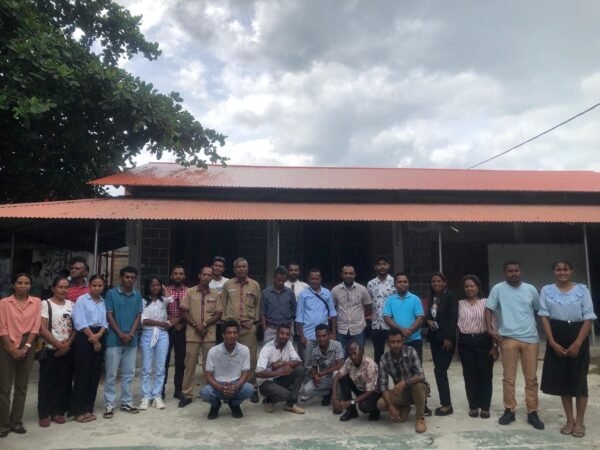
Dili, February 5, 2025 (Média Democracia) – The Timor-Leste Transparency Core Group (CGTL) together with Oxfam Timor-Leste launched a Climate Platform called, “Committee to Climate Change Resilience” in four municipalities.
According to the Climate Change Program Manager, Jemicarter Moniz dos Reis, the main objective of the launch of the climate change committee platform is the principle of opening up space between civil society and the Timor-Leste Transparency Core Group (CGTL) to collaborate to see the climate change situation that is occurring in the country.
“We see the climate fund platform as a source of information related to climate change issues for core issues such as training, workshops and socialization related to climate issues. Because so far we have seen the climate change situation as a major obstacle that is always faced by communities at the village level including municipality,” said the Program Manager
He continued, that is why CGTL collaborated with Oxfam Timor Leste to open this discussion space so that it can present local governments, youth and Hadomi Natureza groups, also at the village level, especially in rural areas.
“In our opinion, there are several groups that stand from agencies and organizations at the village level, so the existence of a climate change platform is an alternative to collaborate with other groups that have existed at the village level,” he said.
He added that at the beginning of this project CGTL thought that the climate platform would be started in 12 villages as follows, Dili four villages, Ermera two villages, Liquiça two villages and Aileu two villages, so CGTL has created a coordination stage through meetings at the village level in order to obtain opinions and recommendations from the community regarding the problems faced by the village.
“We made a proportional estimate that the four villages taken from Dili are also representative villages from Dili, so we took from the East and West at the municipal level, took from the west to the center and then to the north coast,” he said.
He emphasized that this activity budgeted the main funds from the partnership cooperation between CGTL and Oxfam Timor Leste for a special fund for the utilization of climate activities with a total of 100,000. Because, we all know CGTL as a civil society network forum that is responsible for the issue of public accounting transparency.
As the Climate and Climate Finance Program Manager, Lucio José Savio said that Oxfam Timor-Leste is collaborating with the Timor-Leste Transparency Core Group as a partner to look at the climate change issues occurring in the country.
“The climate change resilience platform is an initiative of Oxfam Timor-Leste in collaboration with CGTL which is very important, we know that after climate change we have many commitments like other developing countries. We call rich countries or developing countries that offset the attitude through the contribution of emissions to climate change, so offset it through climate finance.” Said Lucio José Savio
He continued that this climate funding is allocated to countries facing major impacts of climate change including Timor-Leste and other countries in the world. Funds that receive support from developing countries to respond to climate issues that occur in the country especially for people living in rural areas.
“We as CGTL partners feel that this platform is very important so that there are ongoing activities with representatives who participated in this launching ceremony can continue to be responsible for climate finance guidelines to ensure that the funds that come into the country have transparency for social accounting, can raise the attention of women and also the attention of vulnerable groups and the situation when a disaster occurs around them.” He said
He emphasized that climate funds have various sources and now research is starting to be conducted on the responsibility for these climate funds, so that the climate funds that come in are examples of green funds or green climate.
“The bilateral funds are from Australia and also some funds supported by New Zealand including other countries. We are monitoring, but the total climate funds from 2018 to 2023 that we have now is approximately 200 billion allocated to Timor-Leste.” He continued.
He stated that climate funds have two types, such as the Multilateral Climate Fund from JEF and several JCFs from the World Bank, so to apply specifically for JEP and JCF to support the funds must go through approval. Because, institutions that access the funds must have a strong management and monitoring system so that fund owners can trust and agree.
“In Timor Leste, we have seven international NGOs that have accreditation, they can access the ‘gring penafanas’ and ‘global envering facionpplinea’ funds on the other hand, bilateral funds from 10 countries and several institutions that are in Timor-Leste, we re-apply their funds, then we re-implement the climate finance project funds in the country,” he said.
He explained, regarding the criteria related to this type depends on the quality of the proposal we submit based on the requirements they publish, so that we can access funds to be submitted in this country. However, all funds are in the name of the state and citizens of Timor Leste, if these funds require recognition from the state, then it can be known how much financial support and allocated to which parts and how much benefit to the people.
To explain better that actually the climate fund has existed since 2009 but only started conducting research from 2018 to 2023, in the future it will look for data from 2024 so that the data has not been reported so it cannot be accessed. The plan is to collaborate with CJT and APFF-TL every year to monitor how much money goes to Timor-Leste each year.
Reported by : Nelfiano
Picture by : Nelfiano