
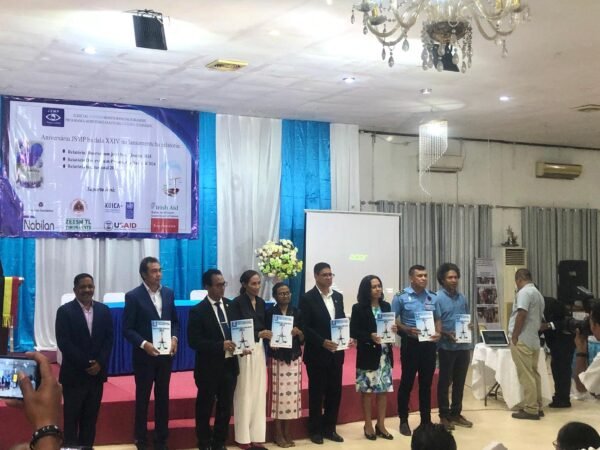
Dili, April 29, 2025 (Média Democracia) – The Judicial System Monitoring Programme (JSMP) marked its 24th anniversary this week with the launch of three monitoring reports: (1) the 2023 General Justice Sector Observation Report, (2) the 2023 Parliamentary Observation Report, and (3) the 2023 Institutional Report. This activity was held on Monday.
JSMP Board President Aniceto G. Berteni stated that JSMP’s work remains focused on the justice sector because the institution identifies progress in the field while also seeking to contribute by detecting the obstacles it encounters.
“Over the past 24 years in Timor-Leste, we have recorded significant achievements in the justice sector. This success should serve as encouragement for all of us, especially in the justice system, to continue working harder to overcome persistent challenges,” said JSMP Board President Aniceto G. Berteni.
He added that JSMP aims to contribute meaningfully in this country, particularly in the justice sector. JSMP does not waste time in contributing its perspectives to relevant stakeholders regarding challenges it identifies, because these issues are not only the responsibility of justice sector entities, but also reflect society’s performance in general, everyone has different roles but shares the same mission: to uphold and strengthen justice in Timor-Leste.
“Our monitoring focuses on two key areas: gender-based violence (GBV) and violence against children (VAC). This work is conducted in the courts of Dili, Baucau, Suai, and Oecusse,” he said.
He highlighted that the reports JSMP publishes annually serve as a reference not only for justice sector actors but also for government institutions to evaluate and shape development and policy plans. These reports help clarify the current state and future direction of the justice sector.
“Our observation of the National Parliament is not to act as a watchdog over Parliament, but to help improve its effectiveness, as Parliament is a sovereign body. If Members of Parliament work effectively, JSMP’s findings can help improve parliamentary performance,” he said.
Monitoring in the National Parliament includes reviewing MPs’ participation and the functioning of parliamentary benches, particularly how they debate public policy, especially justice-related matters. This helps reflect civil society’s opinions and concerns about the obstacles the justice sector faces.
Justice Minister Sérgio da Costa Hornai stated that JSMP plays an important role as a national and international partner. Despite the challenges JSMP faces, the Ministry of Justice continues to support it since its establishment and celebrate its 24th anniversary.
“This work helps you gain a better understanding and become a strong partner at both the national and international levels, in order to align your mission, vision, and main objectives with your status as a non-governmental organization that plays an important role in observing, monitoring, and evaluating the justice sector,” said Minister of Justice, Sérgio da Costa Hornai.
He further stated that the existence of JSMP is like a state institution in the consolidation of state-building, as the government comes with its own vision, and everyone also brings their strong vision in the National Strategic Development Plans for 2011, 2021, and 2030, forming a shared framework.
“We all must strive for integration within our national development programs under this shared framework or roadmap, and strategic plans should not only focus on rights but also reflect back into our programs and strategies, particularly in the justice sector,” he said.
He further explained that from 2011 to 2023, efforts were made to truly understand Timor-Leste’s restoration journey alongside institutional development, identifying five key areas that need to be understood.
“The five important areas include health, in order to strengthen institutional development in the justice sector and address challenges and ongoing programs. We have courts, registered prosecutors, and increasing case arguments at the municipal level, as well as public defenders, official lawyers, and criminal police institutions,” he affirmed.
On the other hand, Secretary of State for Equality Elvina Sousa Carvalho expressed deep gratitude to the JSMP organization, highlighting its important role within the constitutional framework of the state and a democratic nation based on respect for human rights and justice as a fundamental pillar.
“JSMP contributes to development in this country, especially in the justice sector. We all know that JSMP plays a critical and strategic role in guiding and dedicating its work toward improving citizens’ access to the justice system and strengthening legislative functions in Timor-Leste, including for victims of gender-based violence,” said Secretary of State for Equality Elvina Sousa Carvalho.
She added that JSMP is a key partner for the Secretariat of State for Equality (S.E.I), working in coordination to conduct advocacy, draft laws, and propose amendments that ensure responses to issues of gender equality and inclusion.
“We are also very pleased that JSMP today has launched its reports which are the result of dedicated work to reveal the outcomes of its monitoring efforts within the justice sector,” she reaffirmed.
She further explained that JSMP’s reports will provide crucial data regarding citizen access to the judicial system, and the data and reports will serve as recommendations to the S.E.I and other partners to improve services related to gender-based violence, domestic violence, and access to justice for vulnerable groups.
Report: Nelfiano
Photo: Nelfiano