
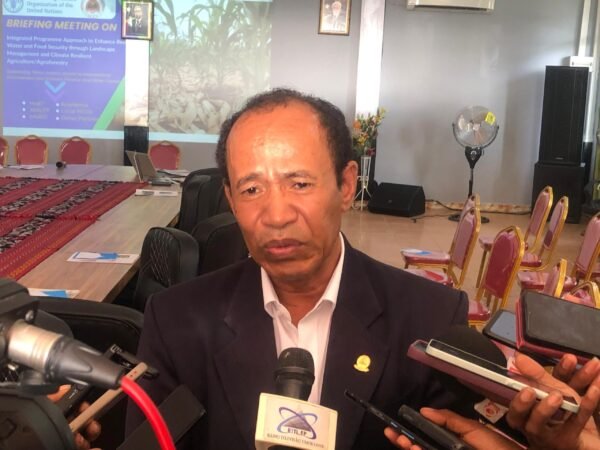
Dili, February 21, 2025 (Média Democracia) – The Ministry of Agriculture through the Secretary of State for Forestry together with the ranks of the ministry held a meeting on integrated program approach to enhance water and food security revenues through climate resilient management landscapes of agriculture and agroforestry. The meeting was held at the MAPPF Hall, Komoro, Thursday.
According to the Secretary of State for Forestry, Fernandino Vieira da Costa, the aim of this dialogue is to shape the future in a sub-science-based way towards a climate-sustainable agricultural system in Timor-Leste.
“Timor-Leste’s rich natural resources and agricultural heritage are vital to people’s livelihoods, but we now face challenges caused by climate change such as water shortages which pose a major threat to food security and people’s daily lives,” said the Secretary of State for Forestry.
He continued, this challenge shows how important it is to take an integrated, nature-based approach to transforming agricultural systems and strengthening climate capacity.
“This meeting is very important with FAO partners to outline the components of the integrated program with the aim of gathering and strengthening collaboration with stakeholders, exploring financial opportunities that are in line with the initiatives being implemented to build direction for effective implementation,” he said.
He added that the plan of the IX Constitutional Government is in line with the integrated program especially in priority sectors such as agriculture, livestock, fisheries and forestry of 70% of the population living in rural areas facing significant problems that have been identified by the government. Agriculture as the key to socio-economic development including to increase food production, livestock productivity opens up the country’s green economic potential.
“We will achieve these goals, but we must not rely only on state funds, we must leverage our capacity to access funds from the global fund, the global environment fund, the grand glamer fund, the JCF adaptation fund, and also other commercial sources within the convention,” he said.
He emphasized that to access the funds, collaboration with accredited identities is needed, for this reason, the ministry ranks are working together with partners who are close to accredited identities and development partners to guarantee funding.
“I would like to ask the identity accreditation to provide an opportunity for government agencies to be able to implement key components of the program directly managing funds to ensure stronger and more competitive national welfare,” he said.
He informed that in this contest the accredited identity program system together with stakeholders was designed to give priority to environmental sustainability and natural resource conservation in order to ensure long-term benefits for Timorese citizens to contribute to national development.
“The success of this program depends on our collective cooperation, compromise and coordination to leverage the assumptions based on the practices of nature, forestry, sustainable and resilient agri-food systems, we can create lasting benefits for our community agriculture and our environment.” He stressed.
He encouraged other ministries rank to continue to actively contribute to the discussions, today we are together building a strong foundation with future initiatives so that Timor-Leste’s agricultural system becomes resilient, productive and sustainable for the lives of all.
To explain better that with development partners such as FAO, UNDP, SAPIP who have been collaborating with the Ministry of Agriculture, but there are also several institutions that have helped and facilitated the Ministry of Agriculture, Livestock, Fisheries and Forestry for many years to be accountable to the people of Timor-Leste, because the people’s money will return to the people.
Reported by : Nelfiano
Picture by : Nelfiano