
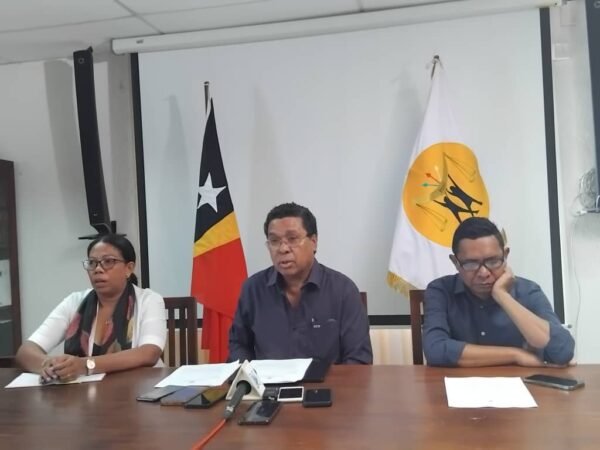
Dili, March 7, 2025 (Média Democracia) – The Provedor of Human Rights and Justice (PDHJ) asked the government to present the Dili Regional Spatial Planning Plan to the community before carrying out evictions.
The purpose of this press conference is to actualize to the public what the Ombudsman has done as stated in Article 30 of Law Number 7 of 2004 concerning the Ombudsman’s Decree that the Ombudsman is tasked with informing the public about all activities that have been carried out by the Ombudsman related to the task of supervision, order, physicalization and the mandate for improving the judiciary submitted by the public.
Previously in a press conference, PDHJ, Virgilio da Silva Guterres “Lamukan” spoke about three things, namely first, abstract supervision of the success of the constitutionality of the law on the appointment of health workers, the circular of the Inspector General of the Ministry of Health prohibiting health workers from practicing in private clinics, second, general supervision of administrative costs that occur in areas such as Fomento, Bebonuk, Becora and other places in Dili. Third, the complaint report received by PDHJ during the period January to February 2025.
First, regarding the administrative costs or evictions. First, the Ombudsman wants to rethink from the beginning, first of all the cost of running the government starts from Bidau and other places, then as a state-owned enterprise the Ombudsman does not oppose the government’s decision or initiative to carry out development to advance Dili, but from the Ombudsman’s observations so far that if this planning process has implications for the distribution of citizens’ rights, then this process must be based on law and must respect the principles of citizen needs and professionalism which are indeed needed when there is damage to residents’ homes.
“Last year the Ombudsman called the relevant ministries to convey this concern and asked the State Ministry to submit the Dili Regional Spatial Planning Plan, so that this plan can be the basis for socialization, and also the basis for dialogue approaches with the affected community, because citizens constitutionally have the right to obtain correct information, especially those related to political decisions that impact their rights, therefore the government must submit a plan so that the community can know that their residential complex is affected so that they have enough time to advocate for their rights.” He said.
He continued, Articles 51 and 58 of the Constitution guarantee the rights of every citizen to priority and every seizure of “damage” that is a priority must be compensated fairly so that if the government does not have fair compensation then the government may not damage people’s homes, for that the Ombudsman through this opportunity wants to ask the government to have a dialogue with the community about who will receive fair compensation for the community.
“The Ombudsman’s concern is on the eviction process that has been going on, the Ombudsman’s observation results show that the approach and dialogue carried out by the government are less than professional, because through the monitoring that we have been doing with the community, they have provided information that they did not receive adequate notification from the government before the destruction of houses occurred and the community regrets the actions that have been carried out by the government, because before the destruction of houses occurred there was no good communication channel with the community.” He added.
He added that through complaints submitted by the community to PDHJ, PDHJ concluded that the eviction process that had been underway was not in accordance with the Regional Spatial Planning Plan.
“The Ombudsman regrets the government’s political decision to ask residents to return to the municipality, because this has violated the constitution of the liberation movement which states that residents have the right to live anywhere, since the past until independence the government has planned to ask residents to move to the municipality, we cannot blame the residents, because irregular urbanization has occurred in Dili since we became independent, residents living anywhere is not their fault, but the government’s fault because there is no good plan to prevent residents from living in the wrong or risky places.” He added.
Through his monitoring, he noted that there had been a violation of good governance practices. Legally, the party that can charge the administration fee is the Ministry of Justice, not the Ministry of State or SEATOU, because SEATOU does not have the competence to charge the administration fee to the public.
“Speaking of this administrative cost, the area that falls under the scope of the Ministry of Justice and Terras Propriedade is not the work of SEATOU, because as I said earlier, SEATOU’s work only looks at residents who occupy public spaces, because some aspects that the Ombudsman sees besides violations of citizens’ human rights, more than 200 families lost their homes, the government also violated good governance practices. We see no communication between ministries in the eviction process.” He said.
Therefore, he wants to immediately recommend that the government can submit the Dili Regional Spatial Plan, if the plan can be submitted to parliament and the public, then the state must use this plan to conduct socialization that provides a basis for the government to conduct dialogue with the affected communities.
Reported by : Domingas
Picture by : Domingas