
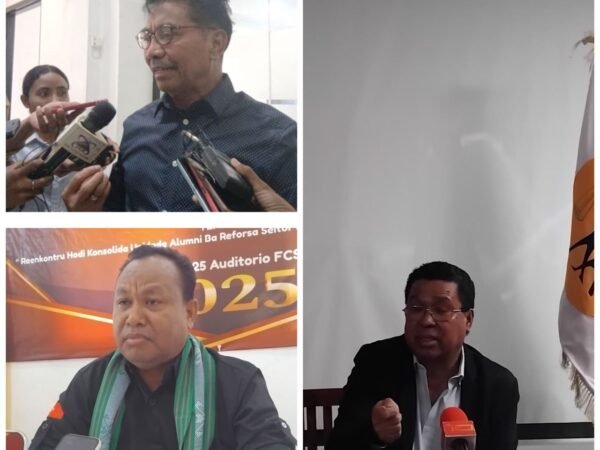
Dili, August 15, 2025 (Média Democracia) – In an interview, the Ombudsman for Human Rights and Justice (PDHJ), Virgílio Guterres “Lamukan,” together with the Director of the Department of Social Communication at the Faculty of Social Sciences, National University of Timor-Leste (UNTL), Roberto da Costa Pacheco, as academics, called on the Secretary of State for Social Communication (SEKOMS) to amend Article 38 paragraph B of the draft Social Communication Law (Lei KomSos), which they believe will undermine press freedom in Timor-Leste.
Ombudsman Virgílio Guterres stated that although PDHJ has previously taken the opportunity to speak with some journalist colleagues regarding this law, PDHJ has not yet officially received the draft revision. However, based on public discussion on social media and among journalists, PDHJ identified several points of concern, particularly an article that deals with criminal responsibility.
“From what I have read and felt, if this article passes, it will not only threaten freedom of expression but also our democracy. Why do I say this? Because the article imposes criminal penalties on people’s opinions, opinions collected by journalists for news content. In newsrooms, we deal with both text and images. Journalists’ work often includes text or images/photographs that reflect the opinions or visual material provided by sources, not the journalists’ own thoughts. If a source expresses their view and a journalist writes it down, the journalist is merely conveying it to the public, not inventing it. Therefore, I believe criminal responsibility should not be placed on journalists for this,” said Guterres at Caicoli, Dili, on August 13, 2025.
He stressed that the essence of democracy is the right of everyone to express their opinions, whether via social media or through journalists, and that journalists are merely channels for disseminating these opinions from citizens. Criminalizing people’s thoughts, he warned, undermines the very core of democracy.
“I consider the articles in this draft revision to be very dangerous for journalists, who must advocate strongly against them. Such provisions should not be included. Journalists must defend their work, whether broadcast on radio, television, or published online, and rely on existing codes of ethics and professional conduct, rather than introducing new penal provisions,” he added.
Guterres reaffirmed that PDHJ will continue to monitor the process, and if the law proceeds, PDHJ will request to participate in hearings at the National Parliament’s Commission A to express their opinion. PDHJ has already instructed its legal team to analyze the draft, particularly regarding press freedom and freedom of expression, which are human rights and citizens’ rights to receive information from journalists.
“When journalists are penalized simply for conveying someone’s opinion, I see it as problematic. If there are shortcomings in the social communication law, we should seek to improve it, not criminalize journalists’ work,” he said.
Meanwhile, UNTL Social Communication Department Director Roberto da Costa Pacheco, speaking as an academic, emphasized that the current draft from SEKOMS, soon to be brought to the Council of Ministers contains in Article 38 paragraph B on criminal responsibility for media products made public. If approved, authors of news articles or images would bear direct legal responsibility.
“From my perspective as an academic, this is a serious threat to democracy in Timor-Leste. Penalizing authors of news or photographs would criminalize those who publish images or reports that may be unfavorable to government members. Those who feel harmed could use this article to punish journalists for their published work,” Pacheco said at Caicoli, Dili, on August 12, 2025.
He highlighted that Article 38 paragraph B states: ‘Authorship of crimes committed through social communication means rests with the person who created the text.’ This means responsibility falls on the individual who wrote the text or took the photo/footage. However, in reality, journalists act as professionals carrying out their duties and should not be criminalized. Even if mistakes occur, the legal responsibility should fall on the media institution they work for, which can then take measures against the journalist internally.
Média Democracia confirmed with Secretary of State for Social Communication, Espedito Loro Dias Ximenes, after his discussions with the Press Council regarding the draft Law No. 5/2014 revision at the Government Palace, that SEKOMS and the Press Council have only just begun their discussions.
“Some content from the draft has already been made public, but the fact is that discussions have only just started. Before presenting the draft to the Council of Ministers and then to Parliament, SEKOMS must first hear from the Press Council. The discussions we have held so far have been amicable and constructive. We agreed to put an end to the current speculation circulating in public, because the draft is still an official government document and cannot yet be made public,” said Ximenes on August 14, 2025 at the Government Palace.
He added that while some people have already sparked public debate about the draft, SEKOMS views this as a positive opportunity for public contributions to the government.
“Our discussions today affirmed that in the Timor-Leste context, the media is a pillar of democracy and plays an important role in nation-building. The media must have strong regulations to protect and ensure its daily work,” Ximenes said.
He explained that the revision’s main aim is to protect and ensure the work of social communication institutions, and that there is no intention to eliminate press freedom or criminalize journalists’ products.
“Many speculations have been circulating that do not reflect the legal context. We want to protect journalists as informers and educators for the nation. Therefore, the government, through SEKOMS and the Press Council, has agreed to simplify and remove detailed provisions in Article 38 paragraph B,” he stated.
SEKOMS reaffirmed that after lengthy discussions with strong consideration for journalists’ profession, democracy, and human rights, they agreed to remove Article 38 paragraph B, eliminating criminal responsibility for journalistic work. The article will instead grant the Press Council greater authority to monitor online media content, since currently its monitoring covers only conventional media.
Reporter: Domingas
Photo: Domingas