
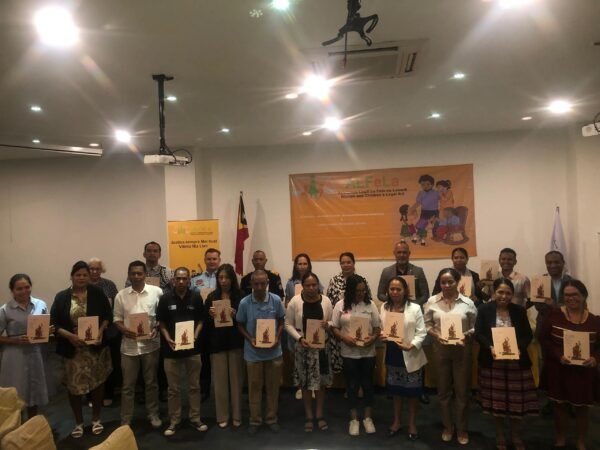
Dili, August 18, 2025 (Média Democracia) – The Legal Assistance for Women and Children (ALFELA) today launched their 2022-2023 annual report under the Legal Science, Legal Education and Advocacy Program, at an event held at Hotel Timor in Dili.
ALFELA’s Executive Director, Marcelina Amaral, stated in her speech that the organization’s mission is to represent women and child victims of gender-based violence. She emphasized that gender-based violence against women and children continues to dominate in Timor-Leste. Data from the Public Prosecutor’s Office and ALFELA itself both show that such cases remain strongly influenced by socio-cultural inequalities that persist in Timor-Leste, affecting women, children, and also including LGBT individuals.
“Despite all our efforts to minimize and eliminate violence through different approaches, experience still shows us that women and children remain in vulnerable situations. This calls for our collective attention so that they can receive maximum assistance in their cases,” she stressed.
She explained that during the 2022-2023 period, many women and child victims were involved in the formal justice system. However, other vulnerable groups such as LGBTIQ+ individuals still lack confidence in accessing formal justice.
“In 2022 and 2023, ALFELA provided legal assistance in a total of 1,220 new cases. Among these, 170 were women and children, and 30 were boys. Services were also extended to two new areas and one older area, with around 200 cases recorded. Domestic violence cases made up the majority, accounting for 60%, followed by sexual violence (SV), sexual abuse (SA) against minors, and 22 cases of incest, as well as other crimes including human trafficking,” she explained.
She underlined that civil cases such as child custody and child support accounted for 15% of new and ongoing cases in that period. Of these cases, 91% have already reached a decision, showing that most victims did receive outcomes in their cases. In terms of access to formal justice, 1% of clients were referred to other institutions, 3% of clients chose not to proceed with their cases in the justice system, and 5% lost contact with ALFELA, often because they moved to other areas without informing the organization or due to costs, with some returning to municipalities.
“ALFELA was able to achieve decisions in 5% of cases where victims expressed satisfaction with their outcomes. However, some were dissatisfied with rulings, largely due to limited human resources in the justice sector, such as judges and prosecutors, compared to the large volume of cases. Among our clients were also 36 people with disabilities, including physical, intellectual, and communication impairments who were in particularly vulnerable situations. In such cases, ALFELA collaborated with the Ministry of Social Solidarity rather than working alone,” she reported.
She added that clients continuing their legal processes also received community support from the government through the Ministry of Social Solidarity. In addition to legal proceedings, they also accessed humanitarian support in relation to their cases.
“Through our legal education program, ALFELA provided training to students, communities, community leaders, police officers, and LGBTIQ+ members. These trainings covered legal frameworks on gender, justice, human trafficking, and family rights. A total of 1,651 beneficiaries participated, including 59 LGBTIQ+ participants, across 10 municipalities,” she said.
On advocacy, she highlighted that during the reporting period, ALFELA contributed to the drafting of child and youth protection legislation, which was later promulgated as Law No. 6/23. ALFELA is now working with civil society and the National Parliament’s Commission F, together with the Ministry of Social Solidarity and Inclusion (MSSI), to implement this law for the protection of young girls and children in the country.
Meanwhile, Deputy Minister for Social Solidarity and Inclusion, Ceo Brites, stated in her speech that gender-based violence is a human rights violation happening in many places worldwide.
“In Timor-Leste, institutions continue to work hard to combat gender-based violence. Globally, 30% of women experience sexual or physical violence from intimate partners, caregivers, or guardians, and this reality is also reflected among government members in Timor-Leste,” said the Deputy Minister.
She went on to explain that Timor-Leste has developed a comprehensive National Action Plan on Gender-Based Violence for 2022-2023, focusing on three key pillars. Through MSSI, the government has made strong commitments, particularly in implementing pillar three on prevention and intervention, ensuring essential services for victims of violence this year.
“Our data show alarming rates of violence. According to the 2016 Demographic and Health Survey, 33% of women reported experiencing physical violence in their lifetime, and 40% experienced physical violence from intimate partners. These statistics still do not capture the full impact of violence on victims’ lives, their futures, and their families,” said the Deputy Minister.
She confirmed that MSSI, in cooperation with the Ministry of Transport and Communications and with development partners, continues to improve the online reporting system and the helpline number 116 to ensure faster and safer reporting of cases of violence.
The event was supported by the TAF-Nabilan Program, WFA, and LWDA through ANCP.
Reporter: Nelfiano
Photo: Nelfiano