
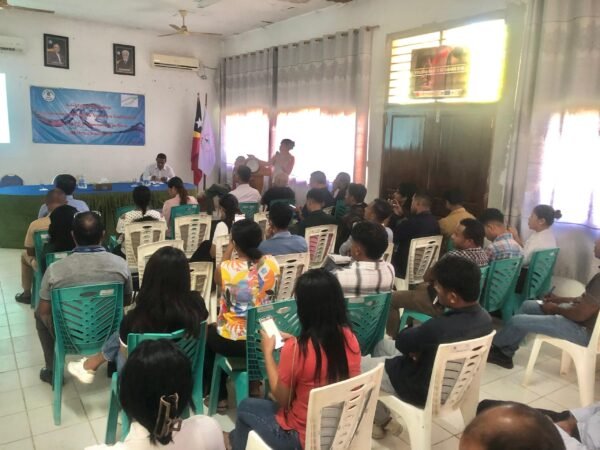
Dili, July 5, 2025 (Média Democracia) – The National Platform for Water, Sanitation, and Hygiene in Timor-Leste (PN-BESI-TL) held a workshop titled “Presentation of Institutional Assessment Results in the Water, Sanitation, and Hygiene Sector.” This workshop took place at the FONGTIL hall in Caicoli on Thursday this week.
The Coordinator of PN-BESI-TL, Januário Amaral, stated that the objective of this workshop, in collaboration with the National Platform for Water, Sanitation, and Hygiene in Timor-Leste and partner NGO La’o Hamutuk, was to present an institutional assessment conducted together with development partners who have been supporting the government over the past 20 years, especially in efforts to ensure development in the water, sanitation, and hygiene (WASH) sector in Timor-Leste.
“This activity focuses on the past 20 years, but we specifically look at the period from 2018 to 2023, to assess how development partners have supported the government both materially and morally in order to help achieve the goals that the government has already committed to,” said Januário Amaral.
He explained that the main focus was on mapping interventions in the WASH sector in Timor-Leste, particularly regarding how much support and budget development partners have provided. This comes in response to challenges faced by the state due to the lack of clear data.
“So far, the government also lacks clear data or mapping regarding the support interventions by development partners, particularly in the WASH sector. Furthermore, in some municipalities, three different organizations may intervene in the same area, while other municipalities may receive no support at all,” the PN-BESI-TL Coordinator added.
He also stated that the government has not given sufficient attention to some municipalities that are still calling for access to clean water. In response to this issue, PN-BESI-TL and NGO La’o Hamutuk conducted a national assessment of agencies to identify which municipalities and areas have received support, and how much budget has been allocated from 2018 to 2023.
From her side, Marta da Silva, Coordinator of La’o Hamutuk, said the objective of this activity was to support efforts in analyzing data for better planning, despite having to “describe” data obtained from various agencies, including through inconsistent portals.
“Our coverage data may rise within a year, but there is no guarantee that it will be sustained in the following years because operation and maintenance issues are not well managed or controlled,” said Marta da Silva.
She added that La’o Hamutuk, together with PN-BESI-TL, conducted this institutional assessment particularly focusing on international NGOs that have supported the Government of Timor-Leste in developing the WASH sector from 2018 to 2023.
On the other hand, Alexo dos Santos, representative from the Water Maintenance Operations of Timor-Leste (BTL.EP), stated that the water and sanitation sector in urban areas is being developed by BTL to respond to basic needs, especially in municipalities.
“The National Platform for Water, Sanitation, and Hygiene in Timor-Leste (PN-BESI-TL) is an association working in the water, sanitation, and hygiene education sector. It is formed by local NGOs working in these areas. In addition, our priority is also focused on urban areas and administrative posts, including municipal capitals,” explained Alexo dos Santos.
He further said that BTL.EP has already entered 48 administrative posts, and this year they expanded to 50 posts.
“For implementation this year, we will also inaugurate 20 new water systems in administrative posts. This means we are continuing to respond to clean water needs for communities, especially in urban municipalities. Our teams on the ground will continue to work hard so communities can access clean water that meets their needs,” he said.
He informed that in the municipal capitals, BTL.EP has received final approval from the Ministry this year. As part of an initiative supported by the World Bank and the Inter-American Development Bank (IDB), implementation will begin in two municipalities: Manufahi and Lautem. The complete development plans include five municipalities such as Dili, Baucau, Lautem, Manufahi, and Viqueque but implementation will start with the two mentioned.
He further explained that the main reason for establishing this platform is to take on an advocacy role in the WASH sector in Timor-Leste, and to ensure national NGOs can participate in political and development processes in the water, sanitation, and hygiene sector in Timor-Leste, leading to inclusive development for the people in this sector.
Report by: Nelfiano
Photo by: Nelfiano