
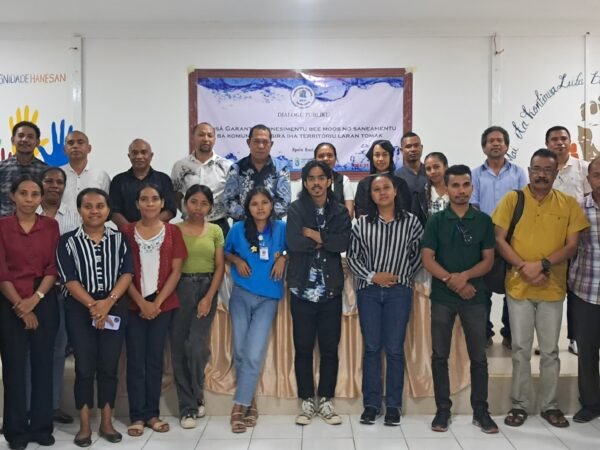
Dili, February 28, 2025 (Média Democracia) – The National Platform for Water, Sanitation and Health, Timor-Leste (PNB-BESI-TL) organized a Public Dialogue with Civil Society Organizations, Local Governments, Academics and Related Institutions on the theme, “How to Ensure Clean Water Supply and Sanitation for Communities in the Region” to conduct a joint discussion among stakeholders on how to find solutions to this problem.
The purpose of this Dialogue is to have a discussion between Civil Society Organizations, Academics, Local Governments and Relevant Ministries, including hearing information and findings, how political plans and priorities are to respond to these challenges.
President of PNB-BESI-TL, Esmenia Laura Ximenes said that the clean water and sanitation sector is a human right and also a basic right in people’s lives.
“All citizens must have access to this sector to ensure a healthy and harmonious life at the family and community level, especially since we know that an important element for national development is access to clean water and sanitation which safe, adequate and sustainable.” Said PNB-BESI-TL President, Esmenia Laura
She informed that the Timor-Leste Government has a national development strategy of 2011 to 2030 which states that by 2030, 90% to 100% of its territory will have access to clean water and adequate sanitation.
“If we want to reflect again on our condition in accessing clean water and sanitation in all regions according to the data we have, especially from the household census which states that around 60% of the population still do not have access to public channels and around 40% still do not have access to basic sanitation,” She said.
PNB-BESI-TL is considered a big problem, the clean water and sanitation sector as a priority sector, also as a political priority from the First Government to the Ninth Government of the Constitution, but back to the allocation of general state funds investment allocated to this sector, from the existing funds only reached around 0.0 to 1.9%. This year, maybe we can reach around 1.3% compared to other sectors.
In the opening remarks, BTL.Ep President Gustavo da Cruz said that in this case, all parties must contribute to ensuring that water reaches the hands of the people and all levels of society, not just the government, civil society, and development partners.
“What is important is that all communities have the awareness to contribute, others do not contribute, like partners and the government make it like a rescue monument, 20 years ago there was a lot of investment, the government and partners did it, but after one or two years we saw water and sanitation facilities become monuments.” Said the President of BTL.Ep
This means that water tanks are used as pig farms, water channels are used as house foundations, and some people use iron to make straw for drying clothes.
The President appreciated PNB-BESI-TL for conducting monitoring and audits to provide input to the Government in order to improve things that are no longer sustainable for the community to access clean water.
“This happens not only because of the quality of work supervision, but also related to our behaviour, if there is a system, this country is not yet advanced, wild, people do not make fields, do not make houses, but these channels have entered their fields, sometimes they have built houses, fields, tie animals there.” He added.
Once this channel is in place, the goal is to channel water to sub-villages that have not been reached, because the roadsides are already damaged, this is not just what the President said, but almost all work partners are facing a situation like this, meaning it is indeed not easy to solve it.
This is like social problems that need to make a good examination so that people can understand about basic work.
He appreciates because civil society supports the government through dialogue like this, to share information with the public to find out that the government does not work alone but there is a partnership of civil society that continues to wake up the government how to be responsible for parents who shout.
On that occasion, the Head of Fomentu III Sub-Village, Filomena Salsinha Gomes added that the canalization of clean water that had just been channeled, the community does not really access this clean water, sometimes water only comes in the morning, or at night. Meanwhile, the water canalization is next to the Esternato School until now the community continues to scream because there is no water.
Meanwhile, regarding this issue, the Head of the Fomentu III Sub-village has been conveyed to the Head of Comoro Village but there has been no response regarding this issue.
Reported by : Estefania
Picture by : Estefania