
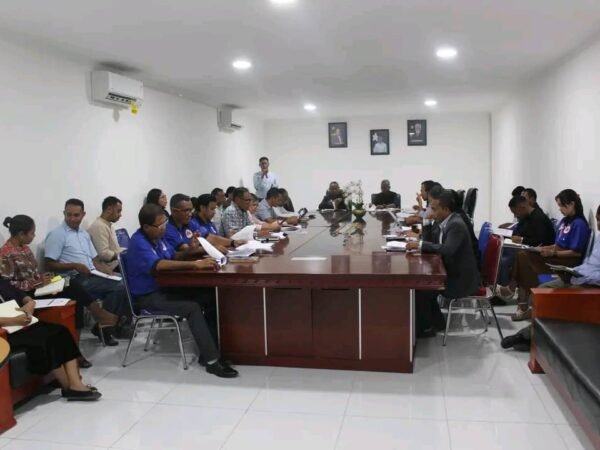
Dili, 08 April 2024 (Média Democracia) – The Secretary of State for Equality (S.E.I), through the National Directorate for Gender Equality Development (DNDIJ), continued its awareness-raising activities in the form of a mini colloquium focused on the Maubisse Declaration Phase III (DM-III) with leaders from the Ministry of Rural Development and Community Housing (MDRHC).
The main objective of this mini colloquium was to introduce the commitments that the Ministry of Rural Development and Community Housing has made under the Maubisse Declaration Phase III. These commitments are expected to be integrated into the ministry’s institutional planning, especially at the directorate and departmental levels, by identifying relevant activities, indicators, baselines, and targets during the implementation period of DM-III from 2023 to 2028.
Representing the Director General, the National Director for Gender Equality Development, José do Rosário de Carvalho, stated that this event is a continuation of similar mini colloquiums already conducted with 17 DM-III implementing ministries, including BNCTL. He emphasized that this opportunity aims to officially introduce MDRHC’s commitment and facilitate the development of guidelines for DM-III implementation.
“The Ministry of Rural Development and Community Housing, as a signatory of the Maubisse Declaration Phase III, will also begin developing its implementation guidelines. This process will commence at the end of 2024 with support from PROSIVU, allowing us to work directly within line ministries to understand how each implementing ministry can develop their own DM-III implementation plans,” said Director José Carvalho in a press release published on S.E.I’s official page, accessed by Média Democracia on 7 April.
The gender commitments within the Maubisse Declaration Phase III (2023-2028) aim to improve, promote, and support the well-being of rural women, aligning with three out of six national priorities outlined by the Eighth Constitutional Government.
“Development of social capital, infrastructure, and the economy from municipal to rural levels. Social capital development includes health, education, and quality of life across various sectors such as agriculture, education, health, tourism, public service, infrastructure, and justice.” he said
The Secretary of State for Equality reaffirmed the government’s commitment to implement the DM-III commitments, particularly by coordinating and providing technical assistance to key partners like SEFOPE, MAPPF, and the Institute for Support to Business Development (IADE) to build the socio-economic capacities of women.
“We will continue supporting gender-based violence (GBV) survivors who have been reintegrated, and work in collaboration with the Ministry of Social Solidarity and Inclusion to provide support and promote leadership and management capacity for young women and women with disabilities in rural areas,” she said.
Through rural-based activities, the initiative seeks to promote respectful and healthy relationships and apply positive approaches to prevent violence against rural women before it occurs. It also aims to increase the number of rural women beneficiaries, including those with disabilities, to access public transfer funds, strengthen women’s economic empowerment, and provide ongoing support through training and assistance.
S.E.I has already established a commission to oversee the socialization, monitoring, and evaluation of the Maubisse Declaration implementation. The goal is to improve institutional capacity to provide sex-disaggregated and categorized data (e.g., by gender, disability status, geographic location, urban or rural age, and others). Institutions will be strengthened to collect such data and establish gender equality centers at the municipal level to support the rural women’s economy.
During the mini colloquium, there were also presentations by Abril S. de Araújo, a technical staff member from the Women’s Economic Empowerment Department (S.E.I), on the content of the DM-III commitments, and by Department Head Herndrique da Silva on the monitoring framework for the Maubisse Declaration Phase III.
The event was attended by Directors General, Inspector-General, National Directors, Department Heads, and staff from the Ministry of Rural Development and Community Housing.
The activity also received strong support from the PROSIVU team, including the GEDSI Coordinator and GEDSI Integration and Monitoring Advisor, who worked to identify baseline indicators and targets to be implemented over the five-year period (2023-2028), contributing to the overall commitment of the Maubisse Declaration Phase III, which the National Commercial Bank of Timor-Leste (BNCTL) has also pledged to support.
Report by : Estefania
Photo by : Official S.E.I Page
Editor by : JP.Costa