
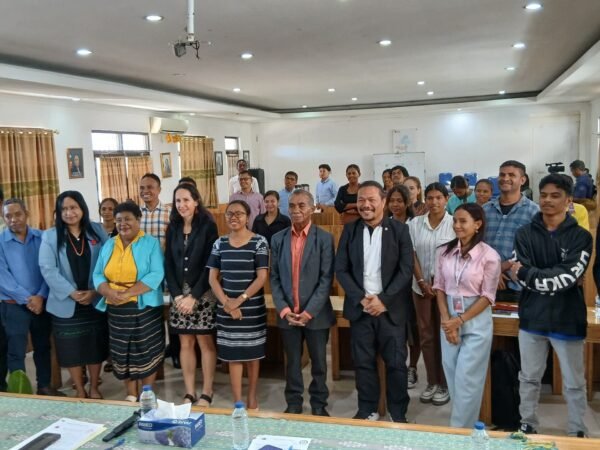
Dili, June 10, 2025 (Média Democracia) – The Nabilan Program, a partnership between the Australian Government and the Government of Timor-Leste (SEI and MSSI), aims to prevent violence against women and children in Timor-Leste. This activity was held in the Maria Correti Hall at SEI, on Monday.
The Head of the Nabilan Program Team, Xylia Ingnam, stated that Nabilan works collaboratively to support gender equality through positive individual, community, activist, and institutional norms, attitudes, and behaviors to prevent violence.
“The National Action Plan Against Gender-Based Violence (NAP-GBV) 2022–2032 gives SEI the full mandate to implement programs aimed at preventing gender-based violence in Timor-Leste, together with implementing partners,” said Xylia Ingnam.
She added that the Nabilan Program is committed in supporting SEI and other entities to strengthen the implementation of the NAP-GBV, including promoting attitude and behavior changes in communities to prevent violence, foster healthy relationships, and share power through radio, print, and social media. This support is aligned with the National Action Plan Against Gender-Based Violence and SEI’s Strategic Plan 2023–2028.
“In Timor-Leste, 59% of women have experienced violence in their lifetime, and 46% in the past year. These high percentages in the Asia region show that there is limited space for women to escape lives of violence. Other data also indicates that Timor-Leste has strong social norms that justify violence against women and children, such as when a woman doesn’t comply with her partner’s demands or in disciplining children,” the Program Head noted.
She emphasized that PNTL data between 2020 and 2023 show that domestic and sexual violence remains high in Timor-Leste. However, there is also evidence that Timorese society considers GBV a serious and important issue that must be resolved.
“Physical, sexual, and emotional violence experienced by women often occurs in the home daily. Now, with online spaces, violence is also facilitated digitally, known as technology-facilitated gender-based violence (TFGBV). One common form is sexual harassment, such as sharing women’s photos, making harassing comments, or sending unsolicited sexual messages,” she said.
She added that data shows many women are currently experiencing this. Some UN reports explain that in certain countries and regions, up to 60% of women have experienced violence via technology.
“Between 2018–2023, the Nabilan Program, in collaboration with SEI, SEKOMS, KITL, and JSMP, facilitated training on gender-sensitive and inclusive reporting and coverage in print and community radio media to ensure publications are gender-sensitive and inclusive,” she affirmed.
She reported that the Nabilan Program continues its commitment to support SEI in conducting training for online media in 2025, in partnership with PCIC, on gender-sensitive and inclusive reporting and coverage in online media. The objective is to increase the knowledge of journalists and newsrooms on how to publish gender-sensitive and inclusive content on social media.
Currently, online media plays a critical role, as many people use it. It can help ensure gender-sensitive reporting and avoid publishing materials that are insensitive or promote violence. Moreover, online media plays a crucial role in influencing community attitudes and behaviors.
At the event, a representative of the National Director of Scientific Criminal Investigation Police (PCIC), Dedi Silva, expressed gratitude to SEI for organizing this event on the 12th to address individual involvement in GBV crimes on social media. He explained that PCIC was created as part of the XI Government’s policy to establish a specialized criminal investigation police force.
“We have already adopted a system of police pluralism, with enforcement based on Article 147 of the Constitution of the Democratic Republic of Timor-Leste, which allows for other police forces created by the State under specific laws,” said Dedi Silva.
He added that discussions often highlight how media significantly influences political decisions because everything tends to be shaped by what goes viral among the public, this is an observation PCIC uses during field investigations.
“Since PCIC’s establishment, we’ve envisioned that in the future, we could prevent crimes committed through technology, especially on social media, where perpetrators violate others’ dignity in this digital age, these are crimes without borders,” he stated.
He explained that communication now has no borders, but there are still some legal gaps that may enable crimes. Therefore, many people are advocating for cybercrime legislation in Timor-Leste, supported by the European Commission, to help compensate for current legal limitations.
He further explained that the Penal Code provides a framework for issues like gender-based violence. However, on the 12th, more data will be published. Yet, information for reporting must respect victims’ rights, and media must request victim authorization before publishing anything. Any release to the public must respect the victim’s dignity as a human being.
Reporter: Nelfiano
Photo: Nelfiano