
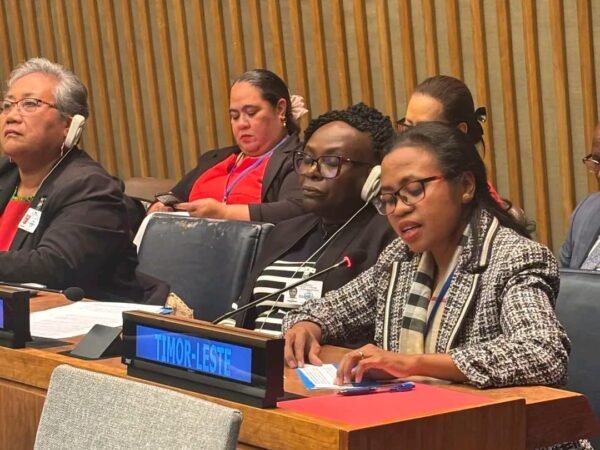
Dili, March 12, 2025 (Média Democracia) – Her Excellency Secretary of State for Equality (SEI), Elvina Sousa Carvalho was a panelist at the High-Level Interactive Dialogue with Regional Commissions on the outcomes of the regional revision of Pekin+30 and the next steps within the scope of the 69th CSW Session at the UN Conference Hall in New York, USA.
In this dialogue, Her Excellency SEI, Elvina Sousa Carvalho congratulated the Leaders of ESCAP and UN-Women who jointly organized and led the assessment process on the implementation of Pekin+30 and on the success of the Asia Pacific Ministerial Conference held in Bangkok in November last year.
“The Pekin+30 revision has provided evidence and a wealth of information on areas where progress has been made and areas that need to be given higher priority, with many countries in the Asia Pacific underlining that gender equality is at the forefront of development and a key component of national development policies, legislation, programs and finances,” said Secretary of State for Equality (SEI), Elvina Sousa.
She underlined several important things that need to be strengthened in the intervention. First, accelerating women’s economic empowerment, given the high proportion of women in informal jobs, work with low wages and high risks.
“It is important to take bold and well-resourced action to talk about key areas to enhance women’s economic empowerment through improving the enabling environment for women to access microfinance credit for the country, expanding access to social protection, removing barriers to access to the digital economy.” She underlined
She said that for Timor-Leste, another important area for enhancing women’s empowerment and economic leadership is improving access to care assistance for women and workers. Investment in this sector will create new opportunities in services, improve conditions of service for care personnel, and promote gender equality.
She said that improving prevention, response and access to justice measures for victims of violence against women and girls, a multi-sectorial approach with community involvement is essential for effective investment.
“To ensure the implementation of PAN-GBV, especially in prevention, service provision and access to justice, it is necessary to improve victim-centered services, social tolerance of GBV fighters through improving policies, legislation and institutional mechanisms to support victims’ and survivors’ access to justice.” She said.
She added that with the increasing participation of women in leadership positions, the Asia Pacific region has made good progress in increasing women’s representation in policy participation.
“Affirmative action measures, such as electoral laws that include packages, have been adopted in several countries in the region including Timor-Leste, these measures are widely recognized as having a positive impact on increasing women’s participation in National Parliaments,” She added.
She further said that there is a need for an integrated approach through gender institutionalization and gender responsive funding to ensure gender responsive governance that allows for significant participation of women and girls and their representative organizations in decision-making and governance processes.
“In Timor-Leste, gender tagging has been integrated into the Public Financial Management System to ensure gender-responsive planning and funding processes that hold the government accountable for implementing gender equality and empowerment of women and girls policies in interrelated areas such as health, education, nutrition, employment, agriculture and social protection and others.” She said.
Before closing, Her Excellency SEI, Elvina Sousa Carvalho emphasized on the collection and reporting of data on gender desegregation and intersession, supporting national capacities in data collection and interpretation to inform the design of gender policies and interventions, continuing to use gender desegregation data in order to enhance gender-responsive governance to ensure the implementation of international and national compromises on gender equality.
Meanwhile, the interactive dialogue was led by the Minister of Women’s Affairs from Colombia, Ing Kantha Phavi accompanied by the Executive Secretary of ESCAP, Armida Salsiah Alisjahbana and other Panelists from ESCAP such as the Minister for the Pacific Region, Her Excellency the Secretary of State for Equality, Elvina Sousa Carvalho and the Deputy Minister and Deputy Head of the National Employment Commission for Girls and Women, State Council of China, Lin Yi. In addition, civil society and youth representatives Mam Rachel Tan, the Official Asia Pacific Forum Program on Women, Development Law, Sivananthi Thanenthiran as the Executive Director of the Resource Center and Research on Asia Pacific Women.
Reported by : Estefania
Picture by : Foto pájina Ofisiál SEI