
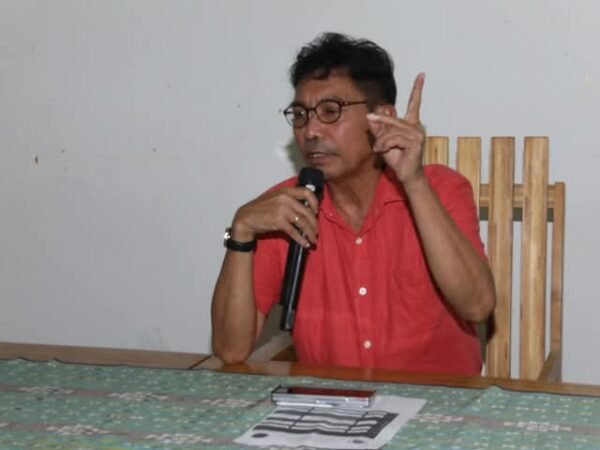
Dili, May 5, 2025 (Média Democracia) — In celebration of World Press Freedom Day, the Secretary of State for Social Communication (SEKOMS) declared its commitment to raising awareness of the Social Communication Law to help improve Timor-Leste’s ranking in the Press Freedom Index.
“In some cases over the years, we’ve seen fluctuations in Timor-Leste’s press freedom ranking. In 2021, Timor-Leste ranked 71st, but in 2022 it dropped sharply to 17th, then down to 10th in 2023, improved again to 20th in 2024, and this year rose to 39th. These scores are based on evaluations conducted by international organizations. Therefore, we need to raise awareness about the Social Communication Law among journalists and all institutions, because journalistic products often affect individuals’ privacy and official state entities,” said the Secretary of State for Social Communication, Expedito Dias Ximenes, in Lecidere Largo, Dili, on last Saturday.
He emphasized that many state institutions still have not internalized policies especially the Social Communication Law and the journalist code of ethics.
“Journalists are often summoned for inquiries, which should not happen. If a journalistic product violates someone’s privacy, there should be a rectification or a right of reply. But often, state institutions are not familiar with or do not apply the proper procedures, particularly concerning the Social Communication Law and journalistic ethics,” he said.
He reaffirmed that SEKOMS will work together with the Press Council to socialize the law with state institutions, clarifying that journalists have freedom but that freedom comes with responsibility.
“Journalists are not untouchable. They can make mistakes. The Social Communication Law allows for rectification when that happens,” he added.
Moreover, SEKOMS, along with the Press Council, is reviewing the Social Communication Law, as the existing version was passed by the National Parliament in 2014 and is now outdated given current technological developments.
“We need to revise the existing law. The revision process is ongoing and will be submitted to the Council of Ministers and then the National Parliament,” he stated.
He also stressed that the IX Constitutional Government places strong attention on freedom in Timor-Leste and broader civil liberties.
“As much as we enjoy freedom, we must also understand our responsibilities. That includes journalists’ responsibility for their work. I believe that discussing press freedom in 2025 means addressing how the Press Freedom Index is evaluated. Reporters without Borders uses five key indicators to assess 180 countries some ranking higher, some lower. These indicators include legislation, security, economy, politics, and socio-cultural context. These are what influence a country’s score,” he explained.
He also spoke about artificial intelligence (AI), saying it resembles a “natural intelligence” that we can utilize to work faster and more effectively. However, if journalists don’t read or research carefully, AI will dominate them.
“That’s why we urge all journalists and media organizations to promote effective awareness about the consequences of artificial intelligence,” he said.
Press Council President Otelio Ote stated that this year’s global theme for World Press Freedom Day focuses on the profound impact of AI on journalism and media. While the principles of a free, independent, and pluralistic media remain crucial, the use of AI for processing and disseminating information presents both innovative opportunities and serious challenges.
“According to UN experts, AI can help support freedom of expression by making access to information easier and allowing more people to communicate globally,” said Otelio Ote.
Meanwhile, Deputy Prime Minister, Coordinating Minister for Economic Affairs, and Minister of Tourism and Environment, Francisco Calbuady Lay, called on journalists to contribute to positive and constructive information for the future.
“I come on behalf of the IX Constitutional Government to ask you to continue your work. Freedom, yes we all live in a democracy but when someone doesn’t like what’s published, they will respond. You carry the moral and professional responsibility of being journalists. I know you’re all doing excellent work. That’s why I ask the press to be positive contributors for the future and to be strong partners with SEKOMS and the Press Council,” said the Deputy Prime Minister.
He reaffirmed his appeal for journalists to work according to the journalistic code of ethics, and to be independent individuals committed to reporting the truth and sharing reliable information with the people of Timor-Leste and beyond.
Reporting: Domingas
Photo: Official Page of the Secretary of State for Social Communication