
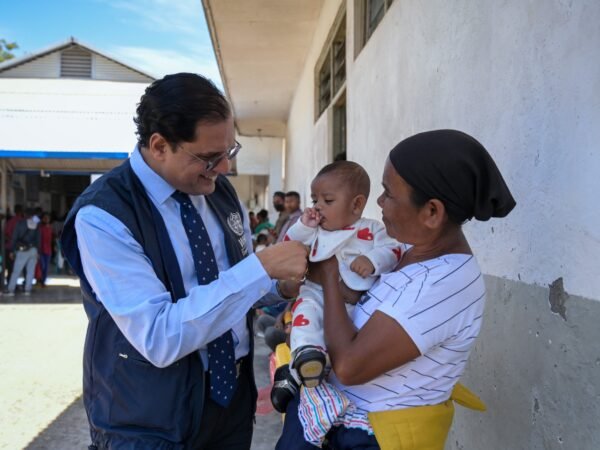
Dili, 08 April 2025 (Média Democracia) – The World Health Organization (WHO) in Timor-Leste celebrated World Health Day by emphasizing investment in maternal and newborn health, a commitment to the future of Timor-Leste under the theme “A Healthy Start for a Hopeful Future.”
WHO Representative in Timor-Leste, Dr. Arvind Mathur, stated that every seven days, one mother or newborn dies due to causes related to infrastructure, lack of transportation, or health personnel who lack skills, deaths that are preventable around the world.
“Maternal and newborn health is a fundamental pillar of a thriving society. The survival of mothers and babies is central to the wellbeing of families, communities, and the nation’s future. Timor-Leste has seen a steady decline in maternal mortality in the Southeast Asian region, yet the maternal mortality ratio remains high (204 per 100,000 live births),” said Dr. Mathur.
He added that although there has been an impressive reduction in under-five child mortality in the past five years, the newborn mortality rate (21 per 1,000 live births) remains high compared to other countries in the region.
“Common biomedical causes of maternal death include hemorrhage, infection, and chronic conditions that go untreated. Birth asphyxia, sepsis, and prematurity contribute to 60% of neonatal deaths,” he said.
Dr. Mathur highlighted that many women in rural and remote areas face significant barriers to accessing healthcare services. First is distance and lack of transportation to health facilities. Second is insufficient healthcare infrastructure and under-skilled health workers, resulting in delays or absence of care. Third, many women still give birth without qualified assistance, and many newborns lack proper care.
“There is strong hope through a multi-faceted approach, supported by strong political will, to improve healthcare access through the flagship initiative of the Integrated Health Program (PIS), which aims to bring services closer to communities,” he continued.
He reported that WHO is actively engaged in these efforts, including strengthening maternal and newborn health services. Together with UNICEF and UNFPA, the Reproductive, Maternal, Newborn, Child, and Adolescent Health Strategy is currently being implemented.
“Maternal and newborn mortality is a preventable tragedy, and it is crucial to learn from these cases to prevent future deaths. A maternal and perinatal mortality surveillance and response system is being implemented by the Ministry of Health with support from WHO, UNICEF, and UNFPA. The goal is to gather and analyze data to better understand delays in care and develop actionable plans to prevent future deaths,” he said.
He also shared that WHO’s Essential Newborn Care course has trained over 100 healthcare providers in neonatal and pediatric units to improve care during the critical “Golden Hour” after birth.
“This training has significantly improved newborn survival rates by equipping providers with updated WHO protocols. I am pleased to note that the national maternal and newborn acceleration action plan, developed with technical support from WHO in collaboration with UNICEF, UNFPA, and other partners through national and local consultations, was launched on the 77th World Health Day, 7 April 2025,” he said.
He emphasized that this action plan lays the foundation to strengthen maternal and newborn health systems and ensure accessible and effective services for all women and children, regardless of their location.
“The Ministry of Health, in collaboration with the Ministry of Social Solidarity and the Ministry of Education, has initiated programs to address the social determinants of health, while continuing to focus on maternal care promotion, supplemental nutrition for pregnant women, early childhood development, and school feeding programs,” he added.
He acknowledged the progress made so far but stressed that more efforts are still needed. The challenges are complex, but continued commitment is essential to overcome them. Ongoing investment in healthcare, training skilled professionals, and ensuring essential health services reach all corners of Timor-Leste remain crucial.
In conclusion, during this 77th World Health Day, let us unite to ensure that every woman has a safe delivery and every newborn has the opportunity to survive, thrive, and reach their full potential. Let us not forget that the health of our mothers and children is a direct reflection of our society’s wellbeing.
By investing in maternal and newborn health, we are not only protecting lives today but also ensuring a brighter, more hopeful, and resilient future for Timor-Leste.
Reporter : Nelfiano
Photo : Nelfiano