
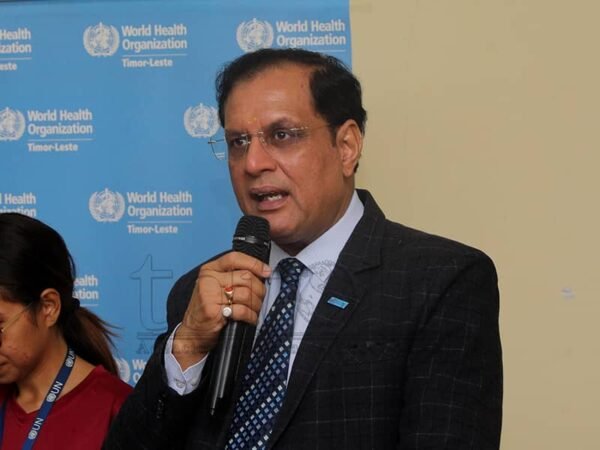
Dili, December 17, 2025 (Média Democracia) – The World Health Organization (WHO) in Timor-Leste carried out activities highlighting Timor-Leste’s progress toward universal health coverage (UHC) for all people.
Arvind Mathur, WHO representative in Timor-Leste, stated in his speech that in Timor-Leste, healthcare is officially free when visiting public health facilities, and patients do not need to pay for consultations or hospital care. Data shows that families spend only a small portion of their income on healthcare in many countries like Timor-Leste. However, for many people, accessing healthcare still comes with high indirect costs.
“Families in remote villages must often pay for transportation to reach nearby ‘free’ hospitals. Vehicle rental, fuel, lack of services, and other additional costs can increase significantly. Some patients delay hospitalization, treatment, or follow-up care because they lack time or money. Free healthcare sometimes feels out of reach,” said Arvind Mathur, WHO representative.
He emphasized that UHC aims to ensure that everyone has access to the health services they need and can be protected from financial hardship.
“UHC Day, celebrated every year on December 12, is a moment for the world to see the distance we have traveled. This year’s theme highlighted that ‘Healthcare costs should not be a barrier. We are ready.’ It reminds us that when people must choose between food and essential services, the health system has not yet fully delivered,” said the WHO representative.
Mathur noted that Timor-Leste understands what decisive actions in healthcare can achieve. In July 2025, Timor-Leste received WHO certification for being malaria-free, becoming the first country in Southeast Asia to reach this milestone. Additionally, lymphatic filariasis was eliminated in just two years. These achievements in public health reflect years of political commitment, community mobilization, and a strong primary healthcare (PHC) network capable of detecting, treating, and preventing infections.
“Now it’s time to focus on UHC goals more strongly. Timor-Leste has the advantage of free services at health points, with the government covering most healthcare costs. Available specialists and quality basic testing continue to expand across facilities, even though qualified health workers are still limited in areas far from Dili,” said Mathur.
He explained that WHO works with the Ministry of Health every year to strengthen gaps in ways that bring Timor closer to UHC. A key focus is ensuring basic healthcare access for everyone. PHC is the key to unlocking UHC, and the government integrates this into its emblematic Integrated Health Program (PIS), a package of services delivered close to communities.
“This year, through PIS, specialists bring services closer to communities, focusing on preventable non-communicable diseases like diabetes and hypertension. Specialists visit community health centers in Dili and Aileu, consulting over 1,000 patients to ensure people do not need costly or time-consuming travel for care,” said Mathur.
He also highlighted the important role of community health volunteers, revitalized with clear roles, training, and modest incentives, helping families trust and engage with the formal health system.
Regarding UHC, Mathur explained that emergency and critical care capacity is increasing, from limited intensive care at HNGV to 75 beds nationwide, including ICU support. Over 1,300 health workers have been trained in emergency and critical care, supported by new simulation centers to practice real-time emergency management.
“Prevention is also crucial. Timor-Leste has strong ‘pro-health’ tax measures, including high tobacco taxes, to curb smoking rates and reduce the risk of heart disease, cancer, and stroke. While not everyone agrees, it is a cost-effective way to protect lives,” explained Mathur.
He emphasized that even small reforms can have a big impact, but collectively, they address the main question of UHC: when people need care, the health system must help them and ensure they get better.
Mathur concluded that with continued investment in primary healthcare, protecting families from high costs and delivering services close to communities, “healthcare for all” can become a reality in Timor-Leste.
Report: Nelfiano
Photo: WHO Media