
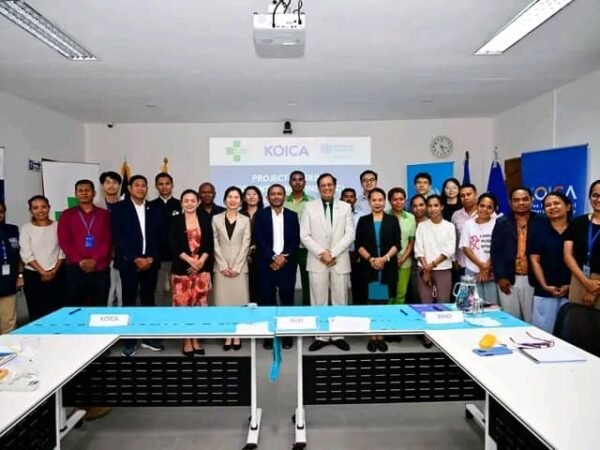
Dili, December 19, 2025 (Média Democracia) – The World Health Organization (WHO) in Timor-Leste, together with the Ministry of Health through the National Institute of Public Health of Timor-Leste (INSP-TL), and in collaboration with the Korea International Cooperation Agency (KOICA), held the fifth Project Steering Committee meeting for the initiative “Strengthening Preparedness and Response to Infectious Diseases in Timor-Leste.” The activity took place at the Ana Lemos Hall, UN House, Dili, on Wednesday.
The WHO Representative in Timor-Leste, Arvind Mathur, stated that since the project’s launch, significant progress has been achieved, including a complete reporting improvement with early timeliness reaching 100% and 99% reporting coverage for diseases detectable on a monthly basis in the sentinel surveillance reports.
“Out of 14 municipalities, 12 frontline graduates from the Field Epidemiology Training Program (FETP) have completed their initial training in May. A total of 40 epidemiologists are now registered as TEPHINET alumni, making Timor-Leste officially recognized as the 84th member of the global network,” said Arvind Mathur.
He added that six FETP fellows are currently undergoing training at Gadjah Mada University in Indonesia, with four more planned for the coming year. Twelve National Health Laboratory officers have completed specialized training at Mahidol University in Thailand, while 12 senior laboratory professionals have received leadership and management training in the Republic of Korea.
“Digital and laboratory capacities continue to be strengthened. At today’s meeting, 80 tablets were handed over to the Ministry of Health for distribution to all Community Health Centers, supporting the transition to a web-based surveillance platform,” Mathur explained.
He further stated that the procurement of 27 laboratory instruments and diagnostic kits is underway and scheduled for delivery to the National Health Laboratory in January next year. These instruments will enable the detection of key pathogens related to diarrheal, respiratory, and arboviral diseases, advancing Timor-Leste toward pathogen-based surveillance in line with global recommendations.
Meanwhile, the Director General for Scientific and Technical Affairs of INSP-TL, Nivio da Costa Sarmento, noted that discussions during the meeting also addressed the current rabies outbreak in the country, highlighting how quickly rabies can spread in the absence of effective surveillance, response mechanisms, and preparedness systems.
“Through active participation and constructive dialogue, this meeting provided an opportunity to reaffirm joint commitments and strengthen coordination among partners. We greatly appreciate the continued cooperation and support from all stakeholders to advance public health capacity in Timor-Leste,” said Nivio da Costa Sarmento.
He added that the handover of 80 tablet PCs during the ceremony marked a significant milestone in supporting digital tools for project implementation and capacity building.
In the same forum, KOICA Country Director in Timor-Leste, Youn Hwa Kang, stated that these achievements have enhanced technical expertise, expanded institutional capacity, and laid the foundation for a more resilient national surveillance system.
“This important work will continue, particularly with the establishment of the FETP Training Resource Center. Once operational, the center will serve as a national hub, providing frontline health workers with the training and tools they need to detect, investigate, and respond effectively to outbreaks,” she said.
She emphasized that as the project enters its final phase, partners agree that the priority is not only to deliver results but also to ensure sustained collaboration and long-term sustainability.
The project is financially supported by KOICA, with technical assistance from WHO, led by the Ministry of Health and INSP-TL. Launched in April 2023, the initiative aims to strengthen surveillance and outbreak response, focusing on two main objectives: improving complete and timely reporting of detectable diseases and building strong national capacity to detect and respond to outbreaks.
Report: Nelfiano
Photo: WHO Media