
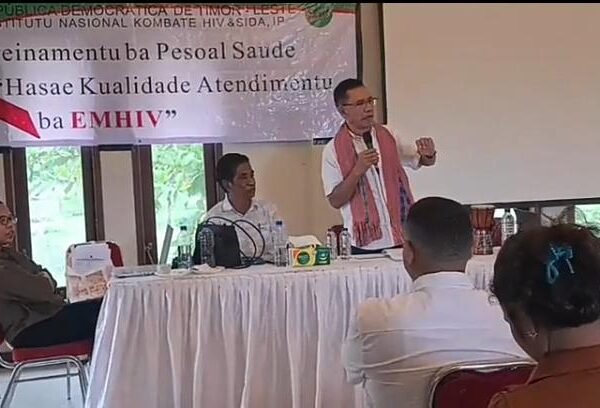
Dili, February 19, 2025 (Média Democracia) – The National Institute for HIV-AIDS Control (INCSIDA) in collaboration with the Ministry of Health facilitated training for health workers in Dili to improve their knowledge in serving HIV-AIDS patients.
Head of the Infectious Disease Control Division at the Directorate of National Disease Control and Primary Health Care Control at the Directorate General of the Ministry of Health, Ambrósio Soares Trindade said that the activity that was held was initiated by the INCSIDA institution which collaborated with the Ministry of Health to organize this training.
“This training is more focused on health workers who have been working in HIV-AIDS and STI programs, so today we invite them to come so that our trainers can further improve their insight and capacity in providing services, because their needs are here, doctors, nurses, midwives in Dili, but not in the Health Center, we also invite health workers from health centers and health centers who are also participating in this training today.” He said.
He also emphasized that the Ministry of Health has a National HIV-AIDS Program, which this plan has been integrated.
“So far our work has been running as usual, from the national level, municipality, health centers, our resources who highlighted, so this work continues as usual, then now there is training to improve their capacity and insight in Dili.” He added.
Because there are many people in Dili, health workers who have not yet received training in collaboration with INCSIDA and the Ministry of Health are holding this training to increase their insight in carrying out their duties.
The Ministry of Health together with partners continues to provide training for a number of health workers who are transferred, for that we continue to provide retraining so that their insight and ability in handling patients infected with HIV-AIDS or those infected with infections, because training for patients must continue to be supported by a sense of responsibility for the treatment carried out during their lives, especially HIV patients.
As the Head of the National Institute for HIV-AIDS Combant, Daniel Marçal said that this training activity was held to provide training to health workers who work in the treatment area and handle patients affected by HIV-AIDS.
“This is very important because our friends who suffer from HIV, some drop out very hard because there are technical questions from our health workers, some have insight some do not, there are attitudes that arise from some of our health workers that make HIV-AIDS patients become restless.” He said.
Because when we do not serve patients well, after they go home they will never come back for a check-up, that is why we see that many of our patients who suffer from HIV drop out very rapidly because firstly they are offended when they seek treatment and secondly they do not come back.
He also informed that some HIV-AIDS sufferers dropped out, because some believed more in traditional medicine promoted via Facebook and YouTube.
“Those who say that HIV can be cured with these drugs, but in fact the world has not found a cure for HIV, our friends do promotions, and finally we see many victims of HIV-AIDS,” he said.
He explained that people who suffer from HIV-AIDS believe more in culture that their culture is able to solve the HIV problem, because there is no culture in the world that is able to cure or kill the HIV-AIDS virus, so that through this insight they can stay away from treatment.
This training focuses on how to increase the capacity and insight of midwives, nurses, program coordinators and counselors, so as not to give rise to attitudes and words that discriminate against members of the community who are infected with HIV, because when they do not consume drugs, the virus will be transmitted to everyone, from women to men, both men to women and husbands to wives and other people.
If health workers have insight, they can attract the public’s interest in taking blood tests, if they are HIV positive, seek treatment immediately, save themselves, it is better to save others, if not, the public is afraid and hides and continues to live a free life, does not know themselves, their HIV status, continues to live a free life with their partners and finally gets infected and positive for HIV-AIDS.
Reported by : Estefania
Picture by : Estefania