
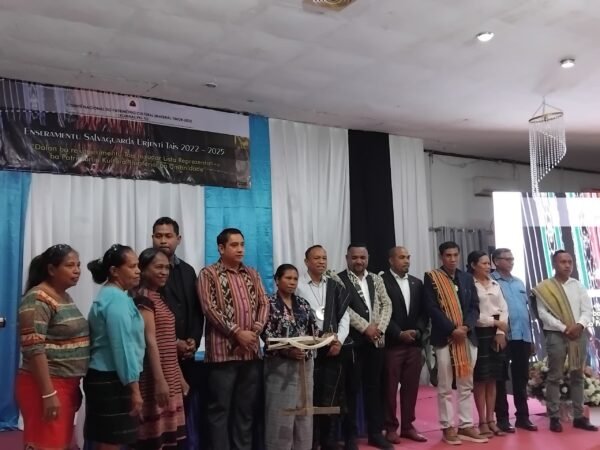
Dili, April 30, 2025 (Média Democracia) – The National Committee for Intangible Cultural Heritage of Timor-Leste (KOMNAS PKI-TL), in collaboration with the Ministry of Commerce and Industry (MCI) and the Secretary of State for Art and Culture (SEAK), held a national seminar on safeguarding Tais as cultural heritage under the theme: “The Path to Recognizing Tais as a Representative List of the Intangible Cultural Heritage of Humanity.” The seminar took place at Delta Nova Hall, on Tuesday.
The President of KOMNAS PKI-TL, Manuel Smith, stated that Timor-Leste has marked a historic milestone, beginning in 2019 when Tais was formally recognized as a cultural heritage asset, and by December 2021, it reached an important global recognition when UNESCO acknowledged Timor’s Tais as intangible cultural heritage requiring urgent safeguarding.
“In the urgent safeguarding process of Tais, UNESCO turned to Timor-Leste to see how the government is paying maximum attention to this issue, ensuring the sustainability of Tais as part of our cultural identity. Through KOMNAS PKI-TL, the government of Timor-Leste submitted an important plan on how to coordinate with ministerial lines and development partners to enhance service capacity and connect with weavers’ networks. This plan was approved and assigned to relevant ministries, starting with SEAK, which holds the competence in discussing research related to Tais,” said the President of KOMNAS PKI-TL.
He added that Tais research conducted in 2021 covered 14 municipalities. This research is part of the urgent safeguarding plan approved by the Cultural Heritage Commission, and included training for female weavers, competitions among them, and workshops on using traditional dyes to revitalize traditional techniques.
“The competition for female weavers and the diversification plan for Tais are coordinated with MCI. To compete in the international market, weavers must be trained in entrepreneurship and encouraged to develop their creativity, allowing them to compete globally. We aim to empower weavers to understand business and improve their skills,” he said.
He also pointed out that nearly every visitor to Timor-Leste looks for Tais to wear, and many young female students are now choosing to wear Tais, aligning with government strategies to promote its use. Furthermore, discussions are ongoing about how to disseminate Tais-related information via social media, a responsibility of SEI, with the goal of promoting awareness in a short timeframe.
“KOMNAS PKI-TL continues to explore how to change the safeguarding status of Tais to the Representative List of Intangible Cultural Heritage of Humanity. We are studying Tais as cultural heritage and implementing awareness programs to establish weaver networks in all 14 municipalities. Contributions from development partners, particularly support from UN Women, have been instrumental. For instance, in Aileu, people once considered weaving sacred, but Timor-Aid helped establish a weavers’ network, and SEAK launched localized training,” said Smith.
Secretary of State for Art and Culture Jorge Cristovão stated that the seminar serves as part of the state’s recognition process of Tais as cultural heritage, requiring safeguarding in accordance with UNESCO’s global heritage monitoring framework.
“This seminar represents our acknowledgment of Tais as national heritage that must be safeguarded. UNESCO monitors this recognition process, and our efforts must demonstrate ongoing protection and promotion,” said the Secretary.
He expressed gratitude to KOMNAS PKI-TL for its work in safeguarding Tais and promoting cultural identity, adding that SEAK remains committed to supporting these preservation efforts.
“Through collective efforts and support from ministerial lines, we can strengthen the weavers’ network and associated groups. We are also preparing to turn Tais into a viable source of family income,” he emphasized.
He explained that the Safeguarding and Cultural Heritage Identification Program began in 2022 and continues through 2025. This initiative highlights key efforts to safeguard Tais, which has already received UNESCO recognition as global heritage.
Meanwhile, Minister of Commerce and Industry, Filipos Nino Pereira, expressed appreciation for the opportunity to meet with weavers representing all 14 municipalities during this important event. He acknowledged the pride in the joint work done with development partners and relevant ministries.
“From the very beginning, we’ve worked to promote Tais as a national identity, which earned recognition from UNESCO. This is a significant achievement resulting from our collective efforts to defend our national interest and finally receive international recognition,” said the Minister.
He emphasized that Tais reflects each municipality’s unique identity. Without it, a visitor cannot identify someone’s origin. Likewise, Timor-Leste, as a sovereign nation, possesses a distinct identity, with Tais serving as a symbol of the Timorese people. Each municipality expresses its identity through different patterns and colors in its Tais.
“We all agree that preserving this heritage is essential, as it has been passed down from our ancestors to future generations. Therefore, we must continue promoting and safeguarding Tais to ensure it is never lost. This event today is a reminder that we must make serious efforts to preserve our Tais, so it remains part of our future,” he added.
He concluded that the government has made considerable efforts to ensure Tais is not lost and continues promoting it both nationally and internationally, so that this cultural and national identity is never forgotten.
Reporter: Domingas
Photo: Domingas