
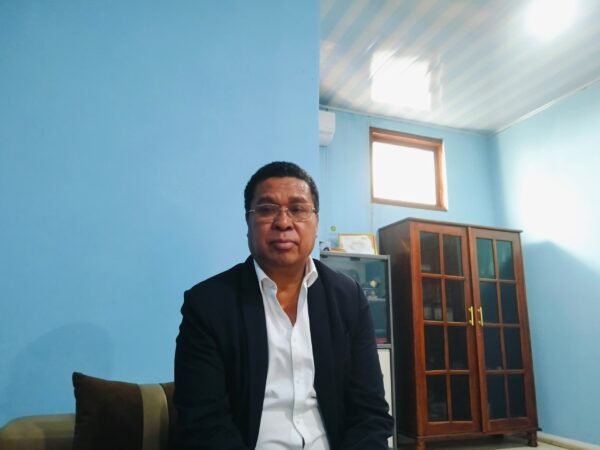
Dili, May 8, 2025 (Média Democracia) – The Ombudsman for Human Rights and Justice (PDHJ), Virgílio da Silva Guterres “Lamukan”, stated that the Secretary of State for Toponymy and Urban Organization (SEATOU) does not have the authority to threaten a Member of Parliament (MP) from the FRETILIN bench with legal action or take them to court.
He emphasized that from a good governance perspective, the actions taken by SEATOU constitute an abuse of power, as the Secretary acted above an MP, who is a high-ranking sovereign body in a democratic nation like Timor-Leste. Regardless of the MP’s political party, no ministry has the authority to threaten or legally pursue an MP, as SEATOU lacks such competence.
“As a government member, if there’s any concern about an MP’s actions, the Secretary should report it to the Prime Minister. It is then the Prime Minister who should present the matter to the National Parliament for political or legal discussion. Threatening to take an MP to court has no place in a democracy the Parliament is responsible for holding the government accountable, not the other way around,” said Ombudsman Virgílio da Silva Guterres to journalists on Wednesday (07/05/2025).
He reaffirmed that MPs act in the name of the people, representing their constituents in Parliament. When MPs see injustice toward the people, they have the right to speak up. This is the legal and regular function of the Parliament.
“It’s unfortunate. What we see here is a clear abuse of power. The Secretary of State, according to the organic law, has no authority to make such threats against an MP who represents the people. SEATOU is not a full-fledged ministry; it is subordinate to a minister. So what the Secretary did is an overreach,” he added.
The Ombudsman stressed that his role is to ensure good governance practices. In this case, SEATOU’s actions removing people from their homes without authority fall outside its legal and political jurisdiction. If such relocation is necessary, it should be done under the Ministry of Justice, which handles administrative resettlements. The current situation is a misuse of power, especially when accompanied by threats to an MP.
“The PDHJ sees this as an abuse of power from a good governance standpoint. SEATOU’s actions against the community are also a violation of human rights. These evictions from quarantine areas were previously declared by the PDHJ as human rights violations,” he explained.
He reiterated that these evictions were carried out without planning, strategy, coordination, or compensation, constituting gratuitous human rights violations. No law grants a secretary the authority to remove communities without due compensation.
“There is no law that says this public space does not belong to the people. This is a continuing human rights violation and a disgrace to the state. The government seems disorganized, unlike the former regimes under Portuguese or Indonesian rule that at least directed people to designated municipalities. In Dili, informal settlements grew unchecked, such as in Bairro Pité, Surikmas, and Kamea. Yet now the state suddenly removes people without first providing proper alternatives,” said Virgílio.
He suggested that the government must first present a comprehensive urban plan for Dili. Only then can it determine which communities and how many families are affected, and who has a right to compensation. Identification must come first, only afterward can people be relocated and then compensated. If people are removed first and paid later, the state must at least provide temporary housing.
He emphasized that the Ministry of State Administration (MAE), according to its organic law, is responsible for managing reception centers. Therefore, MAE should have prepared locations to accommodate those relocated from Fomento, Bidau-Senggol, and Tasi-Tolu. These people should have been able to stay in dignified places while awaiting compensation, as required by Article 1 of the Constitution, which enshrines the respect for human dignity.
Report: Domingas
Photo: Domingas