
Dili, September 15, 2026 (Media Democracia) – The Government, through cooperation with the Timor-Leste Football Federation (FFTL), will develop the Lagoa III João Paulo II area, Tasi-Tolu, into an international-standard stadium, which will contribute to the development of sports and recreation in Timor-Leste.
Besides the stadium, the Government and FFTL will also develop the Lagoa III area into an integrated trekking zone and green zone. With this development, Tasi-Tolu will become an integrated center for sports, tourism and recreation activities.
FFTL Executive Member, José Luis Oliveira, said that until now Timor-Leste doesn’t yet have an international-standard stadium that can represent national identity and pride.
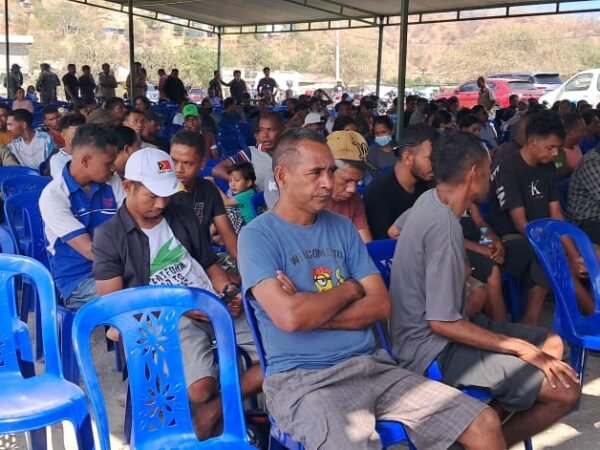
“Until now we still don’t have a stadium to represent Timor-Leste. Because of that, like it or not, we have to have a stadium that can represent national pride. If we don’t have a stadium, when there are international games we have to rent a field in another country,” said José Oliveira during his remarks at a dialogue with the affected community in Tasi-Tolu, Aldeia João Paulo II, on Tuesday (15/09).
Regarding this situation, he said FFTL already has a plan to build an international-standard stadium, with support from the International Football Federation (FIFA).
“Our responsibility is to build a stadium in this location. Previously the Government gave land in another area, but the Church also has its own plan. So, the Government decided to offer this land to us to build sports infrastructure,” he stated.
José Luis also expressed appreciation to community members who are ready to collaborate and contribute to the realization of this project.
“Your collaboration can be considered as your contribution to this stadium. Because in the future, when this stadium is built, we can say that I also contributed to the realization of this project,” he emphasized.
He explained that according to the preliminary plan, FFTL will develop Lagoa III into a green zone and trekking zone. FFTL will not only use the Behind Altar area and the former exhibition area for the construction of an international-standard football field, but will also develop the Lagoa III area into a green zone and trekking zone.
“In this area, Behind Altar and Lagoa III are what we are asking to develop into a field and this stadium. It’s not just a stadium, but there will also be a gymnasium and a green zone to protect the environment. The Lagoa III area will also be developed into a trekking zone, to facilitate community members to practice sports activities and physical exercise,” said FFTL Executive Member, José Luis.
The FFTL Executive Member said the project is not only to develop a stadium, but also to build other facilities that can benefit the community and further beautify the area.
“Because of that, we are thinking of protecting Lagoa III. We are also thinking of integrating the development of the trekking zone and green zone through the stadium construction process,” he concluded.
On the same occasion, the Director-General for Lands and Property, Lucas António da Costa, stated that the IX Constitutional Government has already made a decision to use the location for the construction of an international-standard stadium.
“Why do we want to do this? because we have now joined ASEAN. Therefore, one of ASEAN’s requirements is that Timor-Leste must have an international-standard stadium. So, we have already decided on this location to build the stadium,” he said.
He said the construction of the international-standard stadium and indoor futsal field will occupy a land area of 12.5 hectares.
“Therefore, we will conduct a survey of the houses and plants that are within the 12.5-hectare land area. After that, we will carry out the process according to needs. If you do not agree, we will talk with MOP. If there are plants that you are not happy to remove, we will talk with MAPPF,” he added.
In the same place, the Secretary of State for Lands and Property, Jaime Xavier, said that the construction of this stadium will help reduce FFTL’s need to rent fields abroad when preparing players for training and international competitions.
“If we open this stadium here and international games come here, economic activity will increase. Because of that, parents will also benefit from these activities. I give the example of the Díli Municipal Stadium when people play there, community members sell goods and get benefits,” said the Secretary of State for Lands and Property.
Journalist: Estefánia Cardoso
Photo: Estefánia Cardoso