
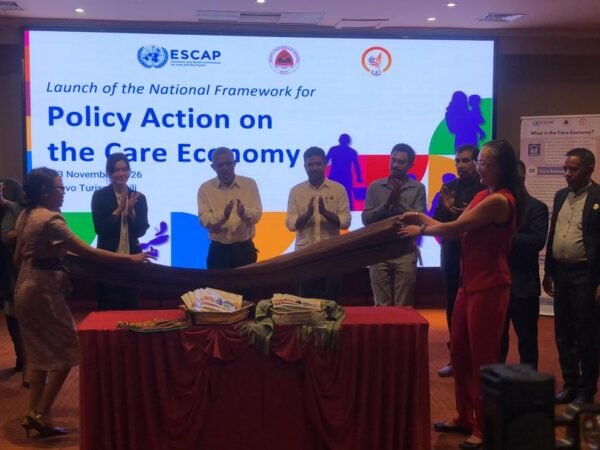
Dili, November 23, 2026 [Média Democracia] – The Secretariat of State for Equality (SEI), together with national and international partners, launched the National Framework for the Care Economy in Timor-Leste, as a strategic guideline to guide the development of a comprehensive, inclusive and resilient care system, respect for human rights and human rights. strengthen gender equality and promote a fair division of care responsibilities in society.
The Secretary of State for Equality, Elvina Sousa Carvalho, affirmed that the launch of the national framework is an important step for Timor-Leste, because care services are not only the responsibility of each family, but also issues directly related to community, gender equality, economy, human rights and sustainable development.
“Care services are often invisible and unrecognized. Care takes place in households, communities and daily activities that support children, people with disabilities, the elderly, and family members in need. Therefore, care services become an important basis for the health, well-being and development of a people,” Elvina Sousa told journalists in Novu Carvalho. Monday (11/23).
He explained that without adequate care services, children will not develop well, the elderly will face difficulties in living with dignity, and people with disabilities will have limitations in accessing their rights and opportunities.
“Around the world, including Timor-Leste, women continue to bear the brunt of unpaid care and domestic work. This situation limits women’s opportunities to access education, employment, economic activity, leadership and participation in public life,” she said.
He continued that the National Study on Care and Unpaid Domestic Work, conducted by the Government in collaboration with the United Nations Economic and Social Commission for Asia and the Pacific (ESCAP) and partners, identified that lack of access to basic services, such as clean water, sanitation, electricity and transportation, increases the burden of women and children. face, especially in rural areas.
The National Framework defines three main objectives. First, to assess the progress that Timor-Leste has achieved in the area of care policy. Second, to identify institutional accountability, gaps in policies and conditions needed to support effective implementation of the care system. Third, to provide guidance for the future, including the development of the National Action Plan, budget calculation, indicator framework, implementation and monitoring mechanisms.
On the other hand, National Program Officer for Women’s Economic Empowerment from UN Women Timor-Leste, Dario Fernandes Doutel de Sousa, affirmed demographic projection for Timor-Leste until 2050 shows that the population of productive age will represent nearly 70% of the total population, while the elderly population will increase to approximately 7%. Urbanization will also continue to increase.
“The urban population in Timor-Leste will increase from 33.2% to 43.7% in the next two decades. These demographic changes will have an impact on the labor market, family structure and the need for care services,” Dario Fernandes Doutel de Sousa said.
He explained these trends will increase the need for care services, but important gaps in the care system will still exist, including high maternal and infant mortality rates, limited access to quality, integrated and accessible care services, and insufficient support for people with disabilities and community care services.
She also emphasized that the responsibility for care services has not been shared equitably between women and men, especially in unpaid care activities in the household.
“The Rapid Care Analysis, conducted by Oxfam, shows that women and girls in the rural and agricultural communities covered by the survey spend almost 3.3 times more time on unpaid care activities than men,” he said.
Although the research focused on a specific community, the results show that the burden of unpaid care work can limit women’s access to education, employment and economic participation, which is a challenge to economic development and gender equality in Timor-Leste.
On the other hand, the President of Manufahi Municipality, Luis Marçal da Costa Tavares, appealed to the community, especially families, to value and promote gender equality, because women have an important role in the economy and daily activities in the household and community.
“We consider gender equality not only the responsibility of the Government or parents, but the collective responsibility of the whole society, which must start from the family itself, through education for children to respect and value women,” he said.
She emphasized that women are not to serve men only, but have equal rights to live their lives, access opportunities and participate in various activities in society.
Reporting: Octaviana da Costa
Photo: Pedrito