
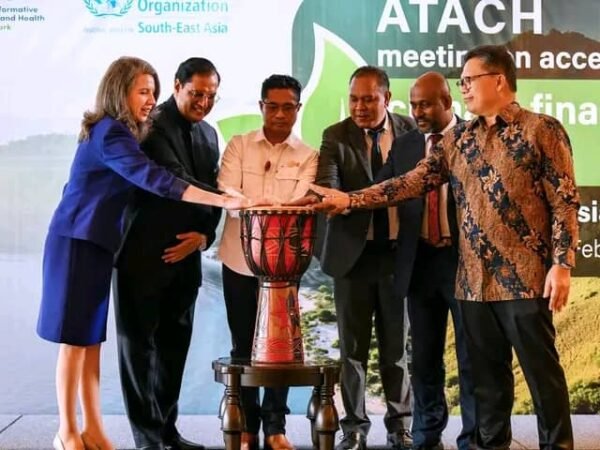
Dili, February 26, 2025 (Média Democracia) – The WHO South-East Asia Regional Technical Meeting on Climate Change and Health is currently being held in Timor-Leste from 25-28 February 2025. The meeting was held at the PALM Spring Hotel Hilton, on Tuesday.
This meeting was officially inaugurated today 25 February 2025 in Dili, Timor-Leste by S.E. Mariano Assanami Sabino the Deputy Prime Minister, Coordinating Minister for Social Affairs and Minister for Rural Development and Communitarian Shelter.
“Climate change is not just an environmental issue, it is a health crisis. For a small island nation like Timor-Leste, climate change is not just a challenge, but an existential threat and a daily reality, requiring urgent action to improve health and build a more climate-resilient, environmentally sustainable and low-carbon health system,” Deputy Prime Minister Mariano Assanami Sabino said.
As conveyed by the Deputy Minister of Health, Flávio Brandão, regarding to Hospital Operations, he expressed his appreciation to the WHO Southeast Asia Region for choosing Timor-Leste as the host of this important meeting.
“This meeting comes at a crucial time to provide a platform to share important insights, learn from each other, build capacity in terms of the tools needed to mobilize technical, financial and human resources in a coordinated manner,” said Deputy Minister of Health, Flávio Brandão.
He continued that climate change continues to be an increasingly urgent global health threat exacerbating existing inequalities and vulnerabilities. The health sector alone is responsible for nearly 5% of global greenhouse gas emissions with the greenhouse effect highlighting the critical need for sustainable and climate-resilient health systems.
On the other hand, WHO Regional Director for Southeast Asia, Saima Wazed conveyed via video message that in the WHO Southeast Asia Region, 8 countries have compromised to build sustainable health systems that are climate resilient and low-carbon within the scope of the COP26 Health Program.
“Many countries in our region are also actively developing proposals for submission to UNFCCC funding mechanisms, such as the Green Climate Fund, the Alliance for Transformative Action on Climate and Health,” said WHO Regional Director for South-East Asia, Saima Wazed.
She continued that ATACH is a WHO-led initiative with a central role in these discussions. ATACH serves as a voluntary global platform for countries and stakeholders to share knowledge, enhance technical cooperation, and accelerate action on climate-resilient and sustainable health systems.
“This initiative was launched in response to the compromises made at COP26 to highlight the priority of integrating climate and health into national, regional and global policies. As a small island developing country, Timor-Leste is highly vulnerable to the impacts of climate change,” She said.
She added that the country is facing rising sea levels, extreme meteorological events, salt intrusion and biodiversity loss, threats that have a direct impact on public health. These conditions exacerbate malnutrition, water scarcity, pollution and the spread of diseases that affect various sectors, especially among marginalized and vulnerable populations.
As WHO representative in Timor-Leste, Dr. Arvind Mathur said that climate finance is essential to protect public health, building climate-resilient and environmentally sustainable health systems, and promoting healthy mitigation. However, the health sector faces a number of barriers to accessing climate finance, including a lack of information about available funding opportunities.
“WHO Timor-Leste with the support of WHO Regional remains committed to providing support to countries in the South-East Asia region, to bring together stakeholders and working together we can strengthen resilience, protect health and ensure sustainable development for future generations.” said WHO representative in Timor-Leste, Arvind Mathur
He continued that the regional technical meeting provided an important opportunity for delegates to discuss strategies to access international climate funding and measure the implementation of adaptation and mitigation in the health sector. The discussions will also contribute to shaping the health action agenda for the upcoming COP30.
“This meeting will facilitate the rationalization of financial resources in the areas of health and climate change and strengthen countries’ capacity to access international funds that enable the implementation of health adaptation and mitigation actions,” he said.
This high-level meeting brought together delegates from 10 WHO South-East Asia Member States, specialists from WHO headquarters and regional offices, as well as representatives from donor agencies and collaborative partners.
Reported by : Nelfiano
Picture by : Media Officer of WHO