
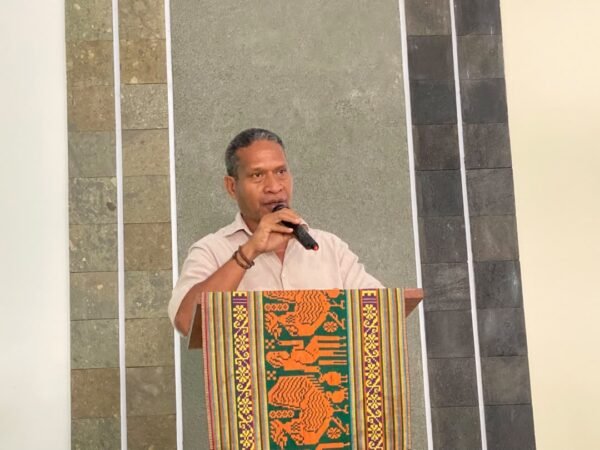
DILI, November 24, 2026 [Média Democracia] – Mata Dalan Institute for Strategic and International Studies (MDI-SSI) organized a panel discussion with students and government representatives, to analyze strategies to strengthen the local economy and promote economic diversification in Timor-Leste, especially after the country became a full member of ASEAN.
The discussion focused on the opportunities and challenges facing Timor-Leste in economic development, including improving productivity, increasing local production and reducing dependence on oil and gas revenues.
Executive Director, Mata Dalan Institute for Strategic and International Studies (MDI-SSI), Valentim da Costa Pinto, said the discussion provided an opportunity for students, especially those who study economics and public policy, to share ideas and constructive recommendations for the development of the national economy.
“The recommendations of this discussion will help MDI to prepare opinions to submit to relevant ministries,” said Valentim to journalists at the João Paulo II Hall, Comoro, Tuesday (24/11).
He added that to strengthen the local economy, the Government needs to continue to improve basic infrastructure, such as roads, water and irrigation systems, to support farmers and the private sector to increase production and commercial activity.
In addition, he asked the Government to strengthen the legal framework that protects local products, facilitates access to international markets and takes advantage of Timor-Leste’s accession to ASEAN, through certification and improvement of local product quality.
“We ask the Government to continue to support productive youth, women and men, to develop economic initiatives and create job opportunities,” he said.
Valentim explained that the Government also needs to facilitate access to credit for the private sector, especially micro, small and medium enterprises, agricultural groups, women’s groups and youth, so that they can invest and increase local production.
“The General State Budget must be inclusive and sensitive to the needs of the productive sectors, to reduce dependence on oil and gas revenues. Revenues from the Petroleum Fund need to be diversified and allocated to the productive sectors,” he explained.
He considered, if the Government makes good management and continues to invest in the productive sector, in the next 10 years Timor-Leste can reduce dependence on oil and gas revenues.
“We need policies that strengthen the partnership between the Government, the private sector and entrepreneurs, to create a favorable environment for investment. Economic development cannot depend solely on the Government,” he said.
At the same event, National Director at the Secretariat of State for Cooperatives (SECoop), Leovilzildo Belarmino, said to develop the local economy, there are three main issues that need attention, namely local production, cooperatives and economic opportunities.
“Local production will face major challenges in productivity, because it has not reached a level that can respond to the needs of the national market. Low productivity is directly linked to poverty, malnutrition and lack of employment opportunities for youth,” said Leovilzildo.
He said, although the Government has made efforts and investment, the local economy continues to face obstacles in productivity, market functioning and competitiveness.
“When we talk about economic growth at the macro level, we also need to look at the economy at the micro level, especially the productive capacity of communities and companies to produce and compete in the market,” he said.
He added cooperatives and micro, small and medium enterprises play an important role in increasing productivity. Data from the Ministry of Agriculture shows that almost 90% of the population is engaged in small-scale economic activities, including agriculture and small businesses.
“In terms of economic opportunities, Timor-Leste’s accession to ASEAN as a full member in October 2025 is an opportunity to open access to regional markets. However, joining ASEAN is not only an opportunity, but also a challenge to improve productivity, product quality and competitiveness,” he said.
Meanwhile, the Head of Namlesu District, Lequidoe Administrative Post, Aileu Municipality, Celestino Ximenes, appreciated MDI’s initiative because it gave the opportunity to various parties to discuss and find solutions to economic challenges in Timor-Leste.
“Although Timor-Leste has gained independence for many years, the national economy is not strong and will depend on other countries. We hope that this discussion can identify obstacles that prevent Timor-Leste from achieving economic independence,” said Celestino.
He said the main obstacle in his community is the lack of labor force in the agricultural sector, because many young people leave their village to continue their studies or look for work in Dili, and some do not return to develop farms and fields.
Another obstacle is the lack of modernization in the production process. Other countries have used modern machinery and technology, but in Timor-Leste, many farmers still rely on manual labour, which limits the productivity and volume of local production.
He also stressed the need to strengthen knowledge and technical capacity to improve the quality of local products, in order to compete in the regional and international markets.
“We learned during the liberation struggle, now is the time to learn and strengthen capacity in the area of economy, to compete with ASEAN member countries. Through learning, cooperation and joint efforts, Timor-Leste can improve productivity, increase local production and strengthen economic independence in the future,” he concluded.
Reporting: Octaviana da Costa
Photo: Octaviana da Costa