
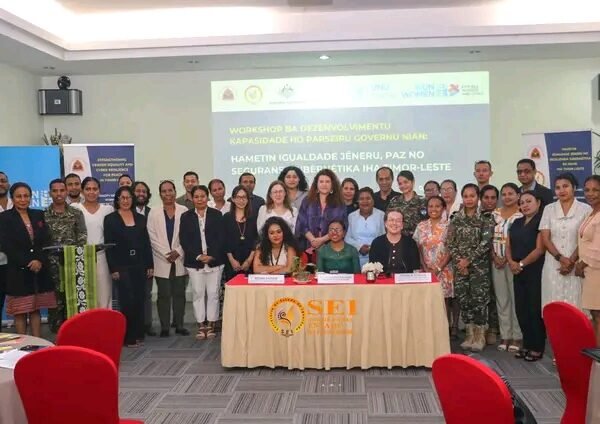
Dili, September 16, 2025 (Média Democracia) – The State Secretariat for Equality (S.E.I), in collaboration with UN Women, has organized the first workshop to promote gender equality and cyber resilience for peace in Timor-Leste. The five-day event, held from 15–19 September at Maubara Room, brings together national and international partners.
According to Jaimee Stuart, a researcher from the United Nations University, the workshop on strengthening gender equality and cyber resilience for peace in Timor-Leste is crucial, as it is jointly organized by the State Secretariat for Equality, UN Women, and the United Nations University in Macau, with support from the Australian Government.
“We see from the data that in Timor-Leste only 34.5% of the population has internet access, compared to 67.9% in other developed Southeast Asian nations. The 2022 Population and Housing Census shows that internet users in Timor-Leste are 59% of men and 46% of women in urban areas, and only 17% of men and 11% of women in rural areas,” the Macau researcher told journalists at Maubara Room.
The researcher added that the data also shows most social media users in Timor-Leste are young people living in urban areas.
Meanwhile, the Secretary of State for Equality, Elvina de Sousa Carvalho, stressed that the workshop is very important, as S.E.I recognizes and addresses cyber threats, including gender-based online violence, cyberbullying, and disinformation, as well as the growing use of online platforms for human trafficking and other forms of exploitation.
“These platforms for human trafficking and other threats are not gender-neutral. The dynamics of power relations, discrimination, and gender exclusion that exist offline are reproduced and even intensified online,” said Secretary of State for Equality, Elvina de Sousa Carvalho.
She added that the Government of Timor-Leste has already taken visionary steps to ensure that its security approaches reflect current realities, particularly the lived experiences of women and girls.
“For example, in the recently adopted Second National Action Plan on Women, Peace, and Security (2024–2028), we adopted a forward-looking and inclusive vision of peace-building, which recognizes cyberspace as a critical domain for advancing the women, peace, and security agenda,” said the Secretary of State.
The UN Women Representative in Timor-Leste, Nishtha Satyam, noted that the latest UN Secretary-General’s report on violence against women and girls highlights how digital technologies are driving new forms of abuse, such as image-based violence, pornography, gender-based disinformation, the spread of hate speech, and gender-based hate and violence. These, she stressed, disproportionately affect women, pushing them to the margins and widening inequalities between men and women.
“We are also concerned about how tech companies are responding to safety and privacy issues. Most rural communities use Facebook rather than Instagram, and many users are unaware of privacy settings,” said UN Women Representative Nishtha Satyam.
She reaffirmed that many users do not know what safety measures are available or how to report harmful content. Therefore, UN Women will continue to work with S.E.I to provide training and workshops that give women safe access to information, helping them prevent online abuse. This is particularly important given that, as the research shows, the majority of active online users are young people in urban areas.
Report by: Domingas
Photo: Domingas