
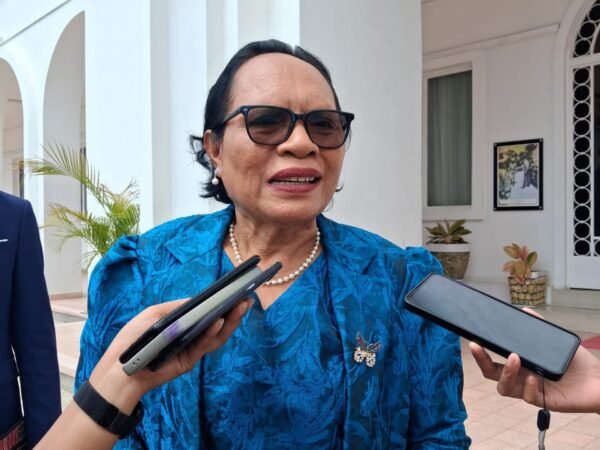
Dili, July 24, 2026 (Media Democracia) – The Ministry of Social Solidarity and Inclusion (MSSI) promises to continue strengthening cooperation with the Ministry of Health to combat leprosy in Timor-Leste, because the latest data from the Ministry of Health shows that the number of leprosy cases continues to be registered at a high level in the country.
The Minister of Social Solidarity and Inclusion, Verónica das Dores, said that leprosy still exists in Timor-Leste. Because of this, MSSI will continue working together with the Ministry of Health to carry out awareness campaigns about leprosy and other diseases, including dengue. It is also important to help communities understand that leprosy can be prevented and that treatment works well when it is detected early.
“MSSI works together with the Ministry of Health and other partners to carry out campaigns on leprosy, through education and raising awareness in communities, schools, and areas identified as high-risk for this disease.” said Minister Verónica das Dores to journalists at the Government Palace in Dili, after the Council of Ministers meeting this Wednesday.
She said that the Government is committed to ensuring that patients suffering from leprosy can receive good treatment and social support. In addition, the Government also ensures that patients don’t face discrimination from families or communities living near them.
“I have always paid attention to the issue of leprosy from the beginning, because the Church is an institution with a mission to advocate on leprosy. We work together to reduce this disease, especially through raising awareness in communities. The Church and MSSI continue to advocate to encourage communities go to clinics and hospitals, and when they receive medicine they must take it according to instructions and not throw it away.” she said.
She explained that MSSI will continue to provide nutritious food support and social assistance to patients in some municipalities, especially in areas where the number of leprosy cases is high. The goal of this program is to help patients continue treatment until it is finished, and to improve their living conditions.
“MSSI appeals to communities to accept and support people affected by leprosy, because this disease isn’t a reason to discriminate against patients. Everyone must pay attention and show solidarity to help them get treatment and live with dignity.” she added.
In addition, the National Director for Disease Prevention and Control at the Ministry of Health, Constantino Lopes, stated that leprosy cases are still being registered in Timor-Leste. According to him, the municipalities with the highest number of cases are Baucau, Dili, and Oecusse, while other municipalities have fewer cases. Even so, the Ministry of Health will continue to carry out screening activities to detect leprosy cases early and provide treatment quickly to patients.
“In some municipalities, leprosy cases are still quite high, for example in Oecusse with 25 cases, Dili with 22 cases, and Baucau with 11 cases. Other municipalities also have cases, but the numbers are lower. Because of this, we now need to continue screening to enable early detection of leprosy.” said the National Director for Disease Prevention and Control at the Ministry of Health, Constantino Lopes, to journalists at Novu Turizmu on Wednesday.
He stated that according to WHO elimination criteria, leprosy has already reached national elimination, but looking at its prevalence, it is decreasing and we still need to find some cases in the community.
“We look at the WHO elimination criteria and leprosy has reached national elimination, but we see that its prevalence is decreasing. However, we cannot yet say it is completely gone. We still need to find some cases in the community, because we don’t know if there may still be cases in the community.” he said.
He added that this is why today the Government, in partnership with the World Health Organization, has launched the Integrated Tuberculosis and Leprosy Screening Program.
“This way we can find more cases in the community. When health teams complete screening and don’t detect cases, or only detect very few cases, then we can enter the elimination category. This integrated screening is for six municipalities, to screen and detect more cases. If integrated screening is completed and no cases are detected, it means leprosy cases in the community are already very few.” he explained.
He added that the Ministry of Health team works together with partners to focus on the leprosy mission, as well as with the Association of People Affected by Leprosy in Timor-Leste.
“In Dili municipality, HAMNASA is currently working with the Ministry of Health to carry out leprosy screening programs. So going forward the screening program will run together, so that the use of resources can be more effective. The intervention for leprosy is treatment for existing cases, with the available medicine used to treat detected cases.” he said.
He also stated that most of these cases require 6 to 9 months of treatment. He said a roadmap for zero leprosy is already in place.
“By 2030 we must report zero leprosy cases in Timor-Leste. The current intervention we are doing is in areas where leprosy is identified. If we find a case we treat it, then family members and close community members, so that we can treat them and see if the bacteria is present and eliminate it so leprosy doesn’t develop in the future. Because the incubation period of leprosy can be from 3 months up to 10 years before it develops.” he said.
Because the leprosy bacteria, once it develops, can take 5 to 10 years, that’s why we need to prevent it early so it doesn’t develop in the future.
“We should be able to reduce leprosy by 2030, because at the Ministry of Health’s board meeting, we saw that leprosy is a priority on how to reduce or eliminate it. That’s why the Ministry of Health recently discussed the 2027 General Budget, which also includes a priority plan for the leprosy program. The Ministry of Health technical team feels it is possible, if all partners work together, because nationally there are 77 cases remaining out of a population of 1.3 million. The rest are very few. If we work harder we can eliminate leprosy and by 2030 we can report zero leprosy cases in Timor-Leste.” he concluded.
Report By: Neliá
Photo: Neliá