
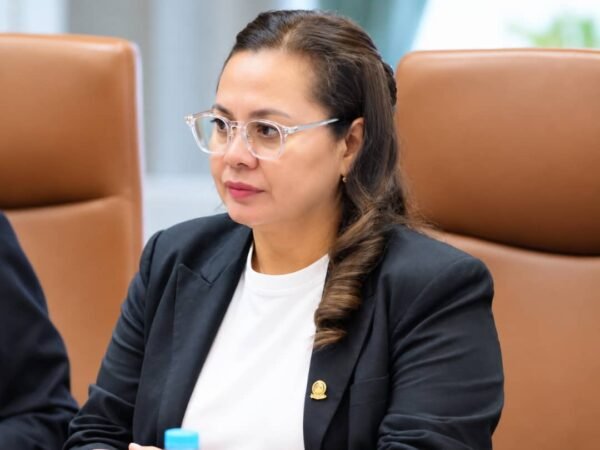
Dili, November 09, 2026 [Média Democracia] – Minister of Health, Élia dos Reis Amaral, explained that medicines that enter the warehouse of the Ministry of Health do not stay long, because they will be distributed directly to hospitals according to need, through a digitalized system. However, the Guido Valadares National Hospital (HNGV) acknowledges that it faces limited stocks of some medicines needed to provide care to patients.
Minister of Health Élia dos Reis Amaral said, with the implementation of the digitalization system, the Ministry of Health can control the availability of medicine stocks and ensure distribution to hospitals in need.
“We know that we have entered the digitalization phase. We know stock out or not, but the stock is not permanent in the warehouse, because when it enters the warehouse, must be distributed immediately,” said Minister of Health Élia dos Reis Amaral, in the National Parliament, Monday (09/11).
On the other hand, according to the Director of Diagnostic and Therapeutic Support Services of the National Hospital Guido Valadares (HNGV), Vidal de Jesus Lopes, acknowledged that the hospital is facing a shortage of some medicines.
“We recognize that the hospital is indeed facing a shortage of some medicine stocks. We cannot say that medicine is available, because it is a matter related to people’s illness and life. In fact, we should find a solution as soon as possible,” he said.
Vidal de Jesus Lopes explained that the main responsibility to ensure the process of purchasing, storing and distributing medicines to HNGV is within the competence of the National Institute of Pharmacy and Medical Products (INFPM), while HNGV focuses on the provision of health services and patient care.
He said HNGV makes requests for medicines to INFPM regularly. The communication process proceeds not only through written request letters, but also through WhatsApp groups, to update and facilitate communication about daily, weekly and monthly medication needs.
The communication aims to ensure that the availability of medicines can respond to hospital needs, so that health professionals can continue to provide adequate care, heal patients and save lives.
He also informed HNGV has 4,600 items of medicines, which are divided into essential and vital medicines categories. However, the hospital is still facing limited stock availability of some medicines.
In addition, Vidal de Jesus Lopes explained HNGV has a specific budget allocation for the purchase of medicines in emergency situations. However, the budget can only be used for emergency needs, not for regular purchases.
He gave an example that, when a medicine is missing, HNGV can make emergency purchases to ensure the availability of medicines for the needs of one or two days, while waiting for regular supply from the competent institution.
Reporting: Octaviana da Costa
Photo: Octaviana da Costa