
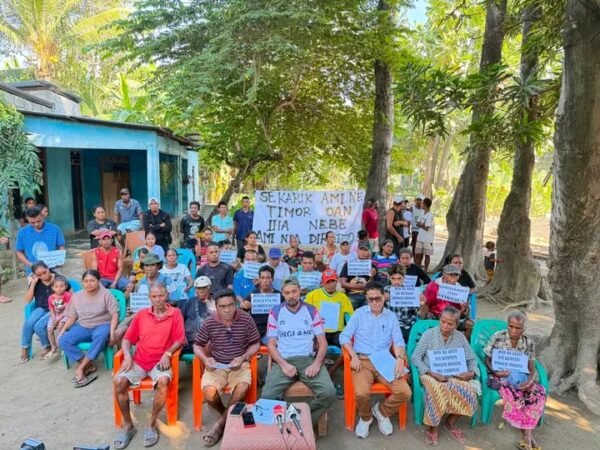
Dili, July 7, 2026 (Media Democracia) – The communities affected by the Presidente Nicolau Lobato International Airport runway expansion project, which consists of the owners and occupants of 57 land parcels currently considered “disputed land with the State,” want to inform the public and the relevant authorities that we don’t agree with the forced eviction measure that the Government, through the National Directorate of Lands and Properties, has notified us of, with a deadline of ten (10) days to vacate the land and houses.
According to spokesperson Helder da Silva, he reaffirms that we, the affected communities, are not against the country’s development and are not against the Presidente Nicolau Lobato International Airport expansion project. We understand that this project is important for economic development and the national public interest.
“Development that is good must be carried out in accordance with the practices of a State of Law, respect the laws in force and guarantee the fundamental rights of citizens. This project affects a total of 215 parcels. Of that number, the majority of owners have already received compensation and indemnification for land and crops. We, 57 parcels, are considered ‘disputed land with the State,’ even though our lands have many documents, historical proof and possession status similar to other parcels that previously received compensation.” said spokesperson Helder da Silva in Marnir (06/07/2026).
He stated, we have all lived on and used these lands for many decades, some since the time of Portuguese administration and continuing through Indonesian administration and independent Timor-Leste. From our perspective, this situation creates different treatment, as a discriminatory act that clearly shows the State using its authority to impose its will. Therefore, we need legal and fair clarification from the relevant authorities.
“On 19 June 2022, the Interministerial Team for the Airport Expansion Project informed the community that those who didn’t agree with the land status could submit a complaint to the Land Commission with their respective supporting documentation. The community followed this guidance and submitted formal complaints. After that, the Land Commission carried out inspections, verification and surveys in the field between 6 and 8 March 2023.” he said.
In the end, the Arbitration Panel of the Land Commission issued a decision that recognizes the rights of the affected communities, such that the affected parties have the right to receive indemnification according to the legal framework applied to this project.
Court Decision Doesn’t Resolve the Land Ownership Issue And Judicial Process is Still Ongoing
He stated that we respect the independence of the courts and we always use legal avenues to seek justice. But it is very important for the public to understand that the court decision that annulled the Land Commission Arbitration Panel’s decision doesn’t legally determine that the land in question is definitively State property.
”The Court only annulled the Arbitration Panel’s decision, but didn’t make a definitive judgment on the merits of the ownership or title of these lands. Therefore, any interpretation that tries to present that decision as definitive proof that the land is State property doesn’t fully reflect the legal content of the court’s decision itself, and amounts to an act of manipulating legal truth. Because the community doesn’t agree with the State’s administrative position, the affected communities have initiated the appropriate legal mechanisms in court to request recognition and declaration of their rights. These processes are currently active in court under the relevant legal mechanisms and are under review by the competent judicial authorities.” he added.
He added, thus, to this day, the issue of title and ownership of these lands continues to be a disputed matter and there is not yet a final and binding court decision that definitively resolves the matter.
“Therefore, we consider that eviction measures before the definitive resolution of the land title dispute can cause serious and irreparable harm to us, the affected communities.”
Concerns about Compliance with National Law and International Standards
We are concerned with the forms and measures that the government is using in the implementation process. Any project that involves the displacement of communities must respect the principles set out in the Constitution of Timor-Leste, including rules on expropriation for public interest, especially regarding fair compensation and guaranteeing adequate living standards.
“This is also as provided for in international standards applied to infrastructure projects that receive support from international development partners such as ADB, JICA and the Australian Government, which establish high respect for the principles of effective consultation, protection of affected people, livelihood restoration and adequate compensation before displacement.”
Eviction measures that are not preceded by a fair and definitive resolution of the land rights dispute aren’t in harmony with these principles.
Appeal to the Government and Development Partners
“Therefore, we ask the Government, relevant authorities and international development partners to: Suspend eviction measures until the land rights issue is legally resolved; Respect the judicial process that is currently ongoing in court; Guarantee equal treatment for all affected communities; Ensure compliance with relevant national laws and international standards. With the capacity and authority it has, the Government must promote genuine and constructive solutions that are fair, dignified and sustainable and continue to respect our property rights, without the need for intervention by judicial bodies.”
He reaffirmed once again that the community isn’t against development. We only ask that development be carried out in accordance with the law, respect citizens’ rights and promote justice for everyone.
Reporting: Tomás dos Santos
Photo: Tomás dos Santos