
Dili, 08 May 2026 (Media Democracia) – The National Directorate of Communication Infrastructure (DNIK) is responding to public concerns regarding the government, through the Ministry of Transport and Communication (MTK), officially signing a contract with Vorakai Company to install Starlink antennas in 450 village headquarters across the national territory. DNIK will clarify and respond to these concerns.
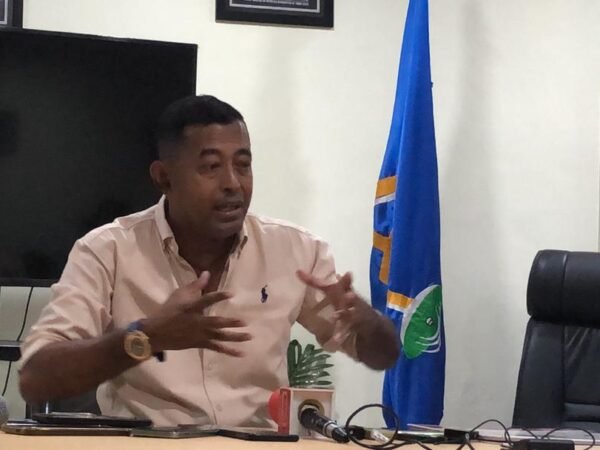
According to the National Director of Communication Infrastructure (DNIK), Ambrosio Amaral, the purpose of this press conference is to clarify the installation of Starlink in all village headquarters, which went viral on social media, and explain why Starlink is being used, as there are many questions related to fiber optics.
“We have no other intention. Technically, we are testing how the installed system can work according to what we want, if we don’t do a trial, if we don’t test, once the contract is signed we won’t know if it will function or not. Testing and simulation started from January-February 2026, and in the end we found a solution that the Starlink network can be integrated into the government’s NGP network so we can control it. So that’s why we tested it. DNIK has a plan to connect fiber optics to villages, but we face budget difficulties. DNIK has a project called the National Connectivity Project (NGP). From phase one to now phase eight, we have laid 1,694 km of fiber optics to state institutions. By the end of May, more than 900 public institutions will be connected.” said the MTC Director at his office on May 7, 2026.
He added that there were budget difficulties in 2026. DNIK planned to purchase fiber optic equipment, but it requires minor capital funding, and in the 2026 budget, only one or two ministries received minor capital. MTK didn’t get approval. DNIK’s budget dropped from $2.9 million last year to $1.9 million this year. The role is big but the money isn’t enough.
“Fiber optics are already in all municipal capitals, and now have reached Administrative Posts. By the end of May it will reach all Posts, but to connect from municipalities to villages requires a lot of equipment that we cannot yet buy because there is no minor capital. The policy is clear that we will install Starlink in remote areas. We cannot yet connect fiber optics to all villages because when we make plans to defend the budget, connecting fiber optics also requires a lot of equipment that must be purchased. DNIK has already conducted trials in villages in Dili together with SECOMS. We know that this year all villages in municipal capitals are to be connected with fiber optics, but the budget is the obstacle. The first proposal from Vorokai Company came in August/September 2025 with a value of $2.3 million. As the technical director, I also have to save state funds.” he affirmed.
DNIK only purchased the kits. Vorokai installed the antennas. DNIK only pays for monthly service. This isn’t permanent. This year DNIK will continue the project to fully lay fiber optics from municipal capitals to all Administrative Posts. When fiber optics arrive we will disconnect Starlink. This is temporary.
“A major concern is network control. We first discussed whether we can control the network or not. In the end, the solution was to connect Starlink’s network to the government’s network so we can control it. Out of the total 450 sucos, nearly 435 sucos have been installed. 15 sucos are not yet done because they are in rural areas, across rivers, such as Suco Guda and Bubususu in Bobonaro. Heavy rain means we cannot pass. Atauro is also almost finished. We are just waiting for communication from the suco chief when the rain stops. We know these 450 sucos each have different distances and geography. That’s why we test and proceed step by step. When the system installation is successful, then we can move forward. According to Article 17 of the MTK Organic Law, DNIK’s role is to ensure connectivity for all state agencies in Timor-Leste territory, including suco headquarters.” he said.
The director reaffirmed that DNIK’s function is as an ISP for the state, not for the public. For the population, that is the role of private operators. Of the 450 sucos, around 25% are currently using satellite means. DNIK’s fiber optics already cover municipalities and have now reached Administrative Posts.
Report By: Trainees Leozalia and Juliana
Photo: Trainee Juliana