
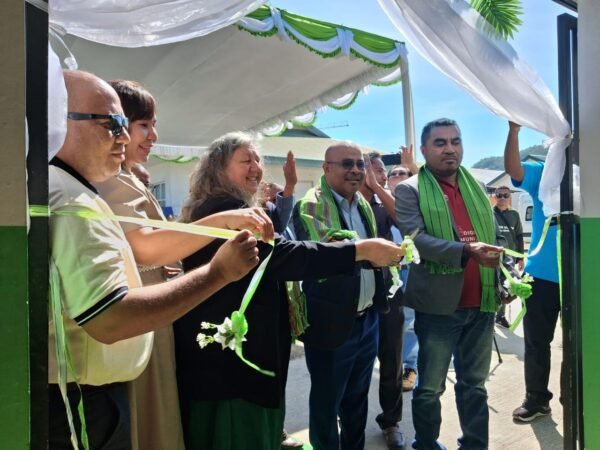
Dili, July 11, 2026 (Media Democracia) – The United Nations Children’s Fund Timor-Leste (UNICEF) officially delivered microwave equipment for medical waste management to the Ministry of Health (MoH), to support the safe treatment and management of medical waste at the Guido Valadares National Hospital (HNGV), HoRES, Maliana Regional Hospital, Maubisse Regional Hospital, Suai Regional Hospital, and Oecusse Regional Hospital, in order to contribute to environmental protection, infection prevention, and public health improvement in Timor-Leste.
The Representative of the United Nations Children’s Fund Timor-Leste (UNICEF), Patrizia DiGiovanni, said she sincerely appreciates the Vice Minister of Health for the strong partnership to improve essential health services so that they can be accessed by the general population including those who are vulnerable and those who are not yet covered.
“My sincere appreciation to the Vice Minister of Health for the strong partnership to improve essential health services so that they can be accessed by the general population including those who are most vulnerable and those who are hard to reach. Thank you also to HNGV and to all regional and federal hospitals for your contribution to ensure that this environmentally friendly equipment can be installed in referral and regional hospitals across Timor-Leste and at HNGV.” said the UNICEF Representative.
She further stated that six medical waste management equipment were delivered, and the equipment is safe and environmentally friendly.
“Delivery of six medical waste management equipment. These equipment will provide a safe and environmentally friendly way to treat infectious medical waste. These equipment will help reduce risks to health workers, patients, and cleaning staff, and communities living near these equipment. They will also reduce carbon emissions and will support a greener environment.” said Patrizia DiGiovanni at HNGV.
The UNICEF Representative in Timor-Leste also stated that the equipment provided by UNICEF is a complete package including installation, operation, and training for health staff, and UNICEF will also provide maintenance support for a period of two years. UNICEF asks the technicians to use this opportunity as a learning opportunity.
“With this equipment, UNICEF provides a complete package including installation, operation, and training for health staff on how to operate and maintain the equipment. UNICEF will also provide maintenance support for the next two-year period to help increase local capacity and to maintain this equipment so it continues to function safely and efficiently. Here UNICEF asks the MoH technicians to use this opportunity as a learning opportunity for the sustainability of the equipment. In addition, UNICEF also supported the renovation of the rooms to house this equipment in the five referral hospitals. This is an important part of the Waste Management System.” said the UNICEF Representative.
On the other hand, the Director General of Hospital Services (DGSH) stated that hospitals produce waste every day. This happens in all health facilities. Until now, health facilities have used incinerators that use fire to kill viruses, bacteria, and microbes. But with this modern facility, the Ministry of Health, through development partnership with UNICEF, will install Microwaves in regional and federal hospitals.
“All hospitals and health facilities produce waste every day. Waste that comes from the provision of health care that happens in all health facilities. Until now, in health facilities we use incinerators that use fire to kill microbes, viruses, and bacteria in the waste that health facilities produce. With this modern facility, the Ministry of Health through the Directorate General of Hospital Services and the National Director for Health Equipment, and also in collaboration with the Department of Environmental Health with support from our development partner UNICEF, conducted an assessment and training to install microwaves or stereowaves to manage health waste which has very big advantages compared to incinerators,” said the Director General of Hospital Services.
In addition, the Director also clarified that he is very grateful for the financial support and provision of equipment at HNGV and also for the five regional hospitals, and hopes to continue to strengthen collaboration in the future.
“We are grateful for this financial support of around 800 thousand dollars for the provision of this equipment at HNGV and also the other 5 regional hospitals. We have the other executive directors from the referral hospitals here today accompanying this process. Today we also heard messages from those who provided financial support and also from the Ministry of Health to take care of these machines and to contact the relevant directorate routinely if regular maintenance is needed. There are two types: one with a volume of 250. Today we saw with our own eyes during the demonstration that a minimum of 40 kilos of waste can go into this machine at HNGV. The ones in the regional hospitals have a capacity of 100, a bit less, about half of the one at HNGV. We can hope that this collaboration does not end and we will continue to collaborate with you. It will not stop, it will be even stronger. We will explore this issue further in the future.” said the Director General of Hospital Services at the Guido Valadares National Hospital (HNGV).
The activity was attended by the Director General of Hospital Services, the Director of HNGV, UNICEF, and doctors. The activity was held in the HNGV meeting hall.
Report By: Nélia
Photo: Nélia