
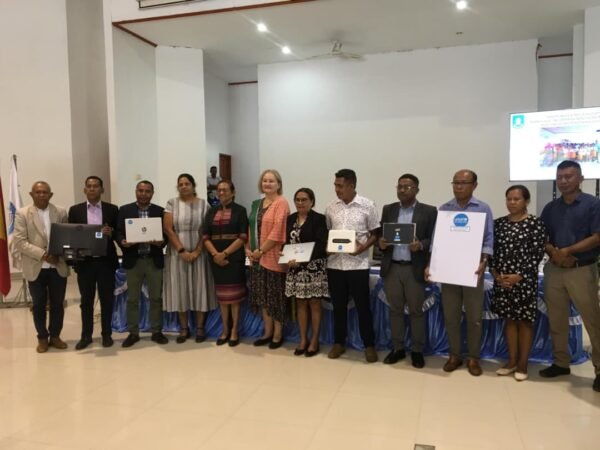
Dili, July 20, 2026 (Media Democracia) – UNICEF Deputy Representative together with the Minister of Education delivered Information and Communication Technology (ICT) equipment to the Ministry of Education to help improve teaching and learning inside classrooms. The equipment totals USD 300,000, to develop their skills, especially for students with disabilities.
According to UNICEF Deputy Representative Teija Vallandingham, information and communication technology is important because it can help students, including those with disabilities.
“Information and communication technology plays an important role in teaching and learning by opening and providing access to global resources for students and teachers both inside and outside of school. ICT promotes inclusive education by accommodating diverse needs, with tools such as screen readers for mobile phones and C-Board, helping students with disabilities to access materials. The use of ICT in education in Timor-Leste continues to move forward but is still limited. Only a few schools have adequate infrastructure, and digital literacy is only taught at the secondary level.” said the UNICEF Deputy to journalists at the Ian Martin Hall, INFORDEPE, on Thursday (16/07/2026).
She emphasized the lack of equipment and trained personnel in ICT, which leads to teaching that is mostly theoretical and new. 63% of teachers have not received digital training, and only 12% believe in using technology for teaching. UNICEF delivered the equipment with the objective of improving teaching and learning inside classrooms and also improving students’ skills.
She added that UNICEF continues to collaborate with the Ministry of Education to digitally transform what is called the “learning passport,” and to support capacity building and equipment maintenance.
“UNICEF is delivering various types of information and communication technology equipment to further support teaching and learning, on-the-job training, and better human resource management. This includes Laptops, Chromebooks, Desktops, Tablets, Projectors, Smart TVs, Servers, and Photocopy machines. As we expand access to digital technology in education, we have a shared responsibility to ensure that these tools are used effectively and responsibly. ICT equipment must support blended teaching and learning approaches to make learning experiences richer and help students develop their digital skills.” she explained.
She stated that this equipment can help the Ministry of Education provide interactive lessons and engage students in new ways. This will allow students to access rich information, collaborate on projects with classmates in the classroom, and develop essential 21st century skills.
According to the Minister of Education, Dulce de Jesus Soares, this activity is not just receiving technology equipment but receiving the key to open the door to improving education in Timor-Leste.
“At this ICT equipment handover ceremony, which is very historic, today we are not just receiving boxes full of technology but we are receiving the key to open the door to an education system that is more inclusive, more dynamic, and looks to the future of children in Timor-Leste. Our country is currently at a point of transformation. We have just finalized the review of the Education Sector Plan 2020-2024. With great pride, I want to share that the new Education Sector Plan 2026-2030 has placed ICT and blended learning as central tools in our national strategy. Digital literacy is no longer a luxury option, but it is a fundamental need that is included in every sector, from pre-school to secondary education.” said the Minister of Education.
She added that the Ministry of Education will take responsibility for the equipment that has been received.
“Today the Ministry takes full responsibility for the large amount of technology equipment that we received: 61 Laptops, 154 Chromebooks, 31 Desktops, 62 Tablets, 64 Projectors, 54 Smart TVs, and 181 Routers. In addition to this, because we understand the infrastructure situation, you also added other essential equipment so that this technology can continue to function, including 37 Generators, 37 Voltage Stabilizers, UPS and other items.” she reported.
She emphasized that the equipment will be strategically distributed to General Directorates and National Directorates, including the General Directorate of Planning, Policy, Inclusion and Informatics, the General Directorate of Pre-school, Basic and Recurrent Education, the General Directorate of Basic Education (DNED), and also to other important bodies such as the Office of the General Inspectorate (Inspectorate-IG).
In addition, she also said this initiative is to improve the quality of teachers’ work and can help make students in the classroom more interesting, interactive, and fun.
“Using ICT in the classroom helps us to teach and learn better than traditional methods. ICT gives teachers new ways to make classes more interesting, interactive, and fun. Teachers can also tailor lessons to the different needs and learning pace of each student. ICT also helps students develop important 21st century skills, such as critical thinking, creativity, teamwork, and digital literacy.” She concluded.
She emphasized that the Ministry of Education decided last year to start the process of reviewing the curriculum that we adopted, the 21st century curriculum. In the 21st century curriculum, technology has an important place. So if we are using or applying technology in the curriculum, then we must also have the equipment itself.
Report By: Trainee Joanita
Photo: Trainee Fizania