
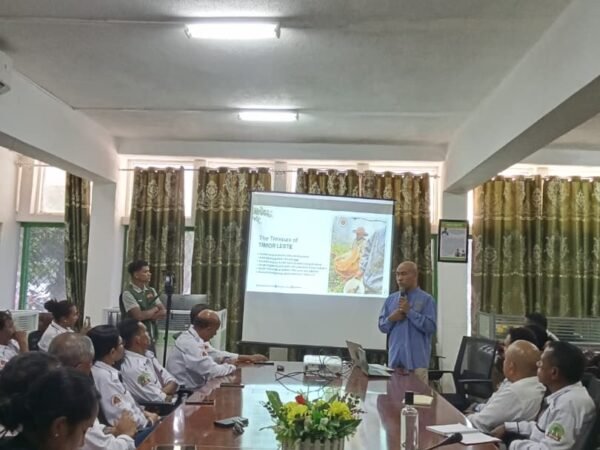
Dili, 26 May 2026 (Media Democracia) – Bali Honey Company presented the results of honey collection in three municipalities such as Liquiçá, Aileu, and Manatuto, to the Secretary of State for Cooperatives (SEKoop). The presentation also included production data, local farmer participation, and the economic impact of the collection program in those three municipalities to support cooperative development and the local product market.
According to the Secretary of State for Cooperatives (SEKoop), Arsenio Pereira da Silva, the program is meant to encourage producers to produce honey so it can be sold on the market.
“With these intentions, these technical issues are needed to push our honey producers to produce, because the market is there. So when quality and quantity are good, we can bring it to market.” said the Secretary of State for Cooperatives (SEKoop), Arsenio Pereira da Silva, at the SEKoop Hall on 25/05/2026.
The Secretary of State also stated that next year they will continue and allocate a budget to the relevant departments to provide training for producers, because to do it well, training is required.
On the other side, the Director of Bali Honey Company, Ismail, said that their observations of honey in Timor-Leste show that honey production in Timor-Leste is very high and that it can be sold on the market.
“We conducted an observation on the potential of bees in Timor-Leste, what can be developed and what the results of the honey are. We did this observation this year, and the data we received is similar to last year, which shows that the potential for honey production in Timor-Leste is still very high.” said Bali Honey Company Director, Ismail.
He added that what’s important now is how producers can produce better honey than before, and then how to sell it in the local market to supermarkets, hotels, and restaurants. For the future, what they want is for Timor-Leste to have more bees that produce more honey, because the potential is very large.
Meanwhile, the representative of honey producers from Aileu Municipality, Domingos Amaral, said that to produce honey you also need equipment to collect it, because they are still using traditional tools.
”From the start SEKoop shared information about Bali Honey, but until now it hasn’t reached us yet, so we’re still using traditional methods in the villages. We haven’t been accompanied yet and the equipment hasn’t reached our place so we can work more modernly like what was presented today. It’s true that in Aileu Municipality we only collect once in 5 years, but if we could collect more, we also need to plant the trees that were presented today. Each year production could increase, but we also have to look at the current climate situation, which is still decreasing. SEKoop is organizing each group and village to follow modern cooperatives.” said Domingos Amaral.
He also stated that regarding the honey collection results carried out across the entire territory, in this presentation Bali Honey presented production data, local farmer involvement, and the program’s contribution to community income. The objective of this activity is to strengthen cooperation with SEKoop to strengthen the market and development of local products.
Reporting: Trainees Novita and Baquita
Photo: Trainee Baquita