
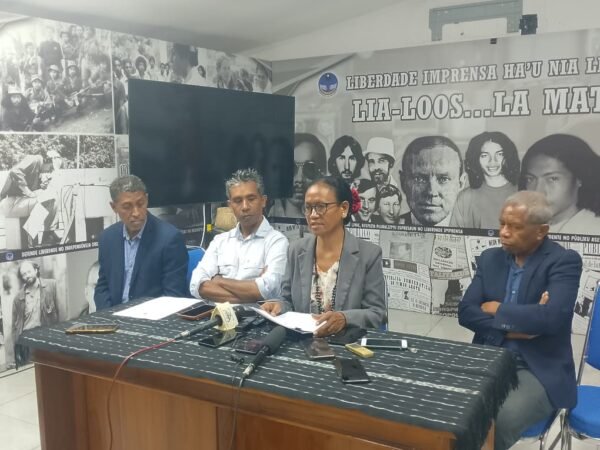
Dili, June 13, 2026 (Media Democracia) – Press Council (CI) holds Press Conference to review this proposal as a serious setback to the democratic consolidation process that the people of Timor-Leste fought long to achieve. During the colonial period and occupation, the people of Timor-Leste lost fundamental freedoms, including freedom of expression and press freedom. At that time, threats to freedom were carried out through weapons, violence and intimidation.
According to Acting President of the Press Council, Suzana Cardoso, the CI views this proposal as a serious setback to the democratic consolidation process that the people of Timor-Leste fought long to achieve.
“Because during the colonial period and occupation, the people of Timor-Leste lost fundamental freedoms including freedom of expression and press freedom, but now we are limiting those two freedoms.” she said during a press conference at the CI meeting room, Kintal Boot, Thursday (11/06).
According to her, Timor-Leste’s struggle for independence didn’t come only from armed struggle and diplomacy, but also from the major contribution of national and international journalists who revealed the reality of human rights in Timor-Leste. Currently, she says Timor-Leste continues to receive international recognition as a country that guarantees press freedom better than others in Southeast Asia.
“Regarding the law model being proposed, the Press Council observes that the inspiration comes from the CPLP system, especially Portugal. But data shows that the European Court of Human Rights often considers decisions on defamation to violate freedom of expression. That’s why many European countries have decriminalized defamation, because it is considered not a good model for a modern penal system. Although there are arguments that this law doesn’t affect freedom of expression, CITL says the provisions in the draft law show a real risk. Prison sentences up to four years for verbal, written or digital statements can create a chilling effect for journalists, activists, academics, and citizens who want to participate in public debate.” she added.
She affirms that although there are arguments that this law doesn’t affect freedom of expression, the provisions in the draft show a real risk.
“Timor-Leste’s democracy is built on the values of openness, dialogue and citizen participation. Therefore, solutions to disputes about honor and reputation must follow democratic and modern principles, not through criminal instruments that can create fear and silence in society. This amendment to the penal code is like an attempt to revive criminal penalties for freedom of expression, with the potential to create a chilling effect for journalists, humanitarian activists and civil society in general, and university students when they exercise their social control function.” she stated.
Meanwhile the CI firmly rejects all legal provisions that criminalize freedom of expression, including penal articles on defamation and insult that threaten freedom of expression and press freedom.
“The drafts must be subject to greater public scrutiny, not protect themselves from criticism using prison threats. The CI is fully committed to upholding the dignity of press freedom and independent investigative journalism, without intimidation or criminalization by authorities. Therefore, they recommend that relevant parties withdraw this draft law from the legislative process and open an inclusive public consultation.” she said.
CI appreciates the statement from the President of the Republic and asks journalists to continue working professionally
The Press Council welcomes and appreciates the statement from the President of the Republic, José Ramos Horta, who said he does not agree with the criminalization of defamation.
“The Press Council also encourages the President of the Republic to continue to maintain this principled position to strengthen protection of freedom of expression, press freedom and democratic consolidation in Timor-Leste. So the CI encourages journalists to continue carrying out journalistic work with professionalism, independence and observance of the Journalistic Code of Ethics, strengthening the check and balance function in the public interest. The Acting President said that if this draft law is implemented they will fight hard for the right to press freedom, expression and freedom. Because press freedom and freedom of expression aren’t a threat to the state, but on the contrary, they are the main pillar for transparency and government accountability.” she reported.
In addition, she also recommends that the government and National Parliament withdraw this draft law from the legislative process and open public consultation.
Meanwhile the CI also asks to prioritize approval of laws that are more important for national development, such as the broadcasting law, personal data protection law and cybercrime law.
Reporting: Tomás dos Santos
Photo: Tomás dos Santos