
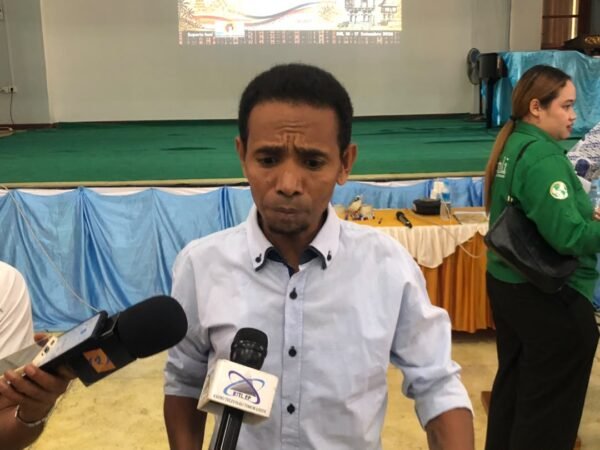
Dili, September 16, 2026 (Media Democracia) – The Executive Director of the Timor-Leste NGO Forum (FONGTIL) considers the eviction that occurred in the capital Dili, which was organized by the Government through the Secretary of State for Toponymy and Urban Organization (SEATOU), together with Market Management, as a form of forced violation against the people, because the process wasn’t prepared with conditions that guarantee dignity for the affected communities.
According to the Executive Director of the Timor-Leste NGO Forum (FONGTIL), Inocênsio de Jesus Xavier, evictions carried out without adequate preparation and planning can have a major impact on community life, especially when evicted people don’t get appropriate conditions to continue living in a new place.
“Including the evictions in Dili, this is a form of forced violation that changes people’s lives and livelihoods. After people leave their place, they don’t get adequate conditions. Although the Government has reason to make a decision or make some changes, there must be adequate information and planning about when to move people, so that people have certainty and can prepare themselves,” FONGTIL Executive Director, Inocênsio de Jesus Xavier, told journalists at the hall of the Catholic University of Timor (UCT), Wednesday (16/09).
He argued that the Government, through SEATOU, has already carried out evictions in many places, but the National Parliament still hasn’t prioritized budget allocation to support the relocation process and compensation for affected communities. He considers that this situation could be a violation of the people’s rights.
“Why is it that now the Government, through SEATOU, is carrying out evictions, but the budget in the National Parliament doesn’t prioritize this? That is the problem. Parliament must allocate money to support relocation to another place. When there is a plan to make a change, there must already be a budget; you cannot make changes without a budget. Until today, some people have not yet received compensation. That is why people react. If people receive money and can move properly, with dignity, that is good,” he said.
He added that when the Government carries out evictions, it must do so with responsibility and consideration for the living conditions of the community, so that the process doesn’t create a forced violation against the people.
“It is not a problem that SEATOU and Market Management prepare cars and transport people to a new place. The problem is when people get out of the car, how are they going to live? How will their children go to school? How will they continue to do business and rebuild their lives? That is what we have to look at. We cannot just look at it as cars or roads. We have to look at it rationally and logically, so that we make public policies that benefit the people. We cannot make a policy that destroys people’s lives,” he concluded.
Reporting: Pedrito dos Santos
Photo: Pedrito dos Santos