
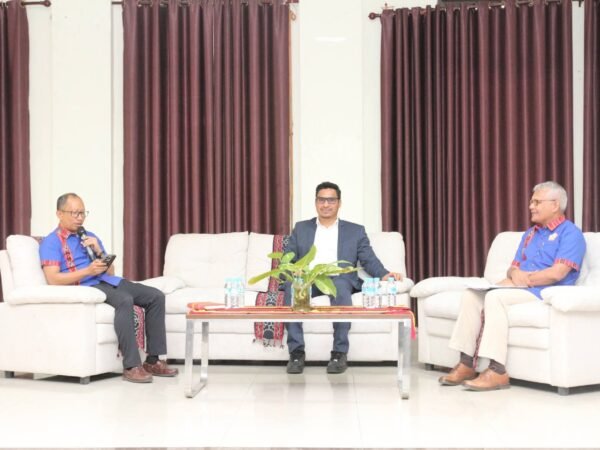
Dili, September 11, 2026 (Media Democracia) – The Central Bank of Timor-Leste (BCTL), together with the Institute of Business (IOB), launched the Timor-Leste 2026 Mid-Year Economic Review, which analyzes the performance and outlook of the national economy, including economic growth, inflation, fiscal policy, the financial system and external position.
According to BCTL Governor, Helder Lopes, BCTL launches two economic reports every year, consisting of a semi-annual report and an annual report.
“The semi-annual economic report is published by us mid-year. So for 2026, this report analyzes the economic performance over six months and we launched it together with IOB. When we do the launch, we also try to share the content of the report with students,” said Helder Lopes to journalists at the IOB campus, Fomentu, on Thursday.
He said that during the launch a panel discussion was also held to talk about the topics presented in the report.
“This is to help students and the public who are following to understand our economic performance during the first six months of 2026,” he stated.
The BCTL Governor also said that the systemic problem currently faced by the banking system and financial industry is mainly related to access to credit.
“Most credit still goes to consumption, while credit for the real sector, the real economy or productive sectors is still minimal,” he said.
He explained that this situation happens because the collateral system is not yet well established. In addition, demand for credit from businesses is also still low.
“That’s why at BCTL we continue to work together with banks and the Government to support our businesses, so that more credit can be channeled to entrepreneurs to support our economy,” he stated.
BCTL also noted that almost US$1.7 billion in bank liquidity is invested or placed abroad.
“We are not very happy with this. We want this money to circulate in our country. But for money to circulate, we must reduce credit risk and there must also be demand from businesses for money in banks,” he stressed.
Because of this, BCTL together with the financial industry and the Government continue to seek solutions to this issue.
Remittances Increase
On remittances, Helder Lopes said the trend over six months shows that money coming in from Timorese workers who work abroad has increased.
“This is good because our people who work abroad send money to support their families and the domestic economy. But at the same time, foreigners who work in our country also send money to their home countries, and this is also in a large amount,” he explained.
He said Timor-Leste needs to create a balance because money in the economy can play an important role like “blood” that circulates in the body.
“So we must ensure that more of the money circulates in our body, meaning the economy circulates in our country and doesn’t go out again abroad,” he stated.
External Trade
On external trade, BCTL identified two main problems: high imports compared to exports, and Timor-Leste’s exports which still depend heavily on coffee.
“One, export volume is small compared to imports coming in. Two, our exports are concentrated only on coffee, and other products are not yet available,” he said.
Because of this, he asked the Government and the private sector to work together to find solutions to increase domestic production and substitute imported products.
“What we import, we can produce domestically to reduce imports. Second, when production is already high and our domestic consumption is not enough, then we can promote exports,” he said.
He stated that through this policy, Timor-Leste can achieve a good external trade balance and benefit the economy, helping to make the national economy healthier.
At the same event, IOB Rector, Pedro Barreto Ximenes, thanked BCTL for cooperating with IOB to launch the 2026 economic report.
“We are very happy because, in this way, BCTL is getting closer to the academic world. Then students can also get alternative perspectives, balance their thinking, their assessment and ideas about what they can do,” he concluded.
Reporting: Octavina Da Costa
Photo: Nelson Ferreira