
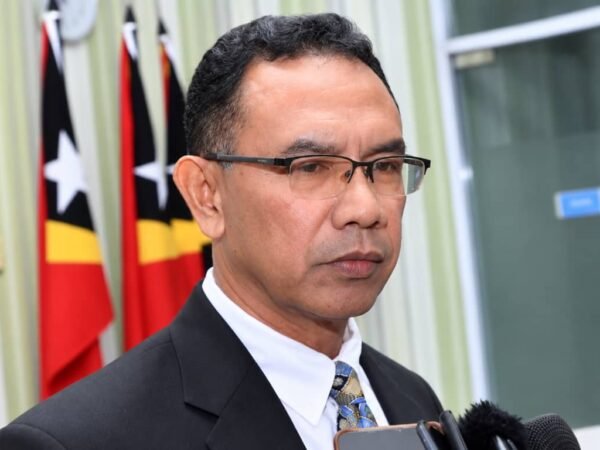
Dili, September 14, 2026 (Media Democracia) – National Institute for Combating HIV-AIDS (INSCIDA) will continue to intensify efforts to raise community awareness about HIV prevention and transmission, especially because to this day there is still no medicine that can remove the HIV virus from a person’s body.
INSCIDA President, Daniel Marçal, said that in order to combat HIV transmission in Timor-Leste, INSCIDA continues to carry out community awareness activities, so that people can protect themselves and increase their knowledge about HIV risks.
“Free sexual relations in Timor-Leste are not regulated, they happen everywhere, and now they have even reached the municipalities, which is a very high risk for HIV/AIDS transmission. Right now our main job is to raise people’s awareness so they know the places and behaviors that are risky, so it’s better to avoid them. Because with the HIV/AIDS problem, there is still no medicine to cure and remove the virus,” Daniel Marçal told journalists at his office, Monday (14/09).
He said that currently most HIV cases are registered among young people of productive age, between 15 to 30 years old. Data presented by the Ministry of Health up to June 2026 shows that HIV cases have reached nearly 2,700.
“Productive age groups, students from pre-secondary, secondary and university, have increased a lot. Up to June, according to data released by the Ministry of Health, we have a total of 2,700 cases. From that data, most are in Bobonaro, Oe-Cusse, Covalima, Ermera and Baucau. Other municipalities also have cases, but the numbers are still small,” he reported.
He explained that the increase in HIV cases in the municipalities is also linked to risky sexual activity. Meanwhile in Dili, HIV cases are also high due to free sexual activity and places that facilitate sexual relations.
“Small hotels have been built right down to the aldeia and suku level. Then there are also massage packages that people use to make money. These conditions challenge us, because people take women there or take men there. The result of our work is that, first, HIV/AIDS cases in Timor-Leste are still relatively low, because many people with HIV take medicine. But that medicine doesn’t cure HIV, it only helps control the virus,” he explained.
Daniel also said that discrimination against people with HIV is starting to decrease, because now more people want to get blood tests to know their health status. In INSCIDA activities, up to one hundred or two hundred people can get blood tests in one activity.
“The problem now is that equipment is also limited. It would be better if more people got blood tests, because when we identify someone with HIV, they can get treatment and live a normal, long life. What we fear is people at risk of HIV who don’t want to get blood tests, because if they don’t know their status and don’t get treatment, it’s dangerous for their lives,” he said.
He said that to this day there is still no medicine that can remove the HIV virus from a person’s body. Therefore, if HIV cases have already reached nearly 2,700 and risky sexual relations continue, the number of cases could increase further.
“The big problem is that some of our friends have sexual relations with multiple partners, but don’t want to use condoms. That’s extremely dangerous. We don’t know if the woman has HIV or if the man has HIV. That’s why the risk is high. I remind friends who like to change partners to be careful. If you have sexual relations with many partners and don’t use condoms, that’s extremely dangerous,” he reported.
Daniel also stated that using condoms is important to prevent HIV transmission, but people must know how to use them correctly, because using condoms incorrectly can also increase risk.
“One thing: HIV/AIDS is very simple for people who have knowledge, but for people who don’t have knowledge, the risk is very high. Now we are working especially with the Ministry of State Administration (MAE) to talk about this problem from aldeia to suku. Suku authorities, aldeia chiefs and delegates must know about this,” he affirmed.
He said local authorities also need to monitor and control places that carry out massage activities or other services, including whether those places have licenses or not and who uses those places.
“Hotels are going all the way to the aldeias. We cooperate with them so they must control it. Otherwise, we see places that are very busy at night, with people going in and out,” he affirmed.
Because of this, INSCIDA is also coordinating with migration authorities to monitor places considered risky, because these activities are not only involving Timorese, but foreigners can also access services in those places.
“We are making all these efforts, but legally there must be some laws and rules, which is why the competent authorities must go down to control. Massage places must have licenses, but we also have to look at the condition of the rooms. We can’t guarantee that people who go into the rooms will only do massages and nothing else,” he said.
Daniel emphasized that the authorities who issue licenses must carry out regular inspections of those places, to check their conditions and the activities carried out inside.
“Because massage isn’t only used by old women; young people and old men also use it. Therefore, those who issue licenses must do inspections to check the items and activities there. Otherwise, the cases can continue to increase. Now we continue to do awareness-raising and blood testing, so we can save and prevent people from HIV transmission and keep them from progressing to the AIDS stage,” he concluded.
Reporting: Octaviana Da Costa
Photo: Octaviana Da Costa