
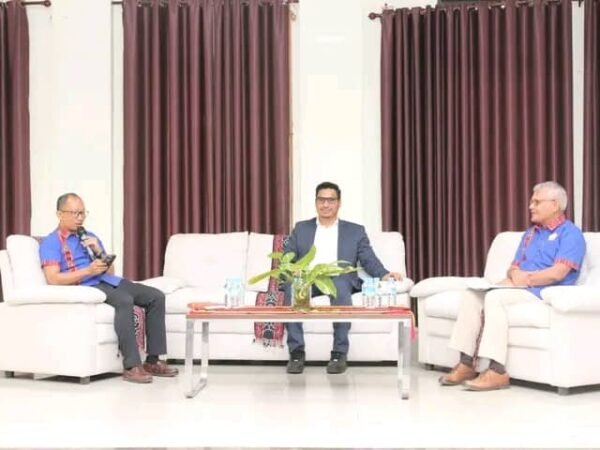
Dili, September 12, 2026 (Media Democracia) – Economists from the Institute of Business (IOB) and the Central Bank of Timor-Leste (BCTL) question the methodology that the World Bank (WB) uses to measure the poverty level in Timor-Leste.
IOB economist, Rui Gomes, said he has not yet read the World Bank report, but suspects that the institution is using criteria that cannot be directly compared with the poverty line used in 2014.
“I haven’t read the report yet, so I can’t comment. But I suspect they are using a criterion that we can’t compare. For example, with the 2014 poverty line, if we want to compare, we have to use the same criteria. But I think they are using a different criterion,” Rui Gomes told journalists at the IOB Campus, Fomentu, on Thursday (10/09).
He stated that the figure of USD 8 per person per day shows that Timor-Leste still does not have the capacity to grow the middle class.
“I think USD 8 per person per day means that we still don’t have the capacity, because our economy and unemployment are still high. We don’t have the capacity to lift our middle class up,” he said.
He emphasized that the main solution to reduce poverty is to create jobs domestically.
“We have to create businesses in the country, like it or not. This is the only solution to reduce poverty. We don’t have any other mechanism. When we do public transfers, many people just consume, but when the transfers end, the poverty problem will still be there. So, we need formal jobs that can sustain people’s daily lives,” he explained.
Rui Gomes also questioned the decline in purchasing power and called for increased productive investment, because the prices of goods increase every year.
“Now my problem is, if over many years the prices of goods keep rising slowly, but our purchasing power doesn’t rise. This is why today people feel that before, with USD 100, I could buy a lot of things, but now I take USD 100 to the market, I can’t buy the same as before,” he said.
In addition, the former minister said that investment must be productive and oriented toward exports.
“Now we are using liquidity from the Petroleum Fund to invest in consumption, but the Petroleum Fund has already declined. So, what then? We have to find another way, we have to create an economic foundation that can sustain our economy going forward,” he said.
He called for a focus on the agriculture sector and on processing local products, to increase value added before exporting abroad.
“We have to go back to the land, plant in our soil and produce a lot to sustain our market, so that we can export. For example, we have a lot of cassava and fruit. We have to find ways to transform them into value-added products, then sell them abroad,” he said.
On the other side, BCTL Governor, Helder Lopes, said that the issue of the World Bank report is mainly the competency of the Government, especially the Ministry of Finance, to respond.
“I think this issue is the competency of the Government, especially the Ministry of Finance, to respond. But what I want to say is that you all need to look at the methodology used to measure poverty in the World Bank report,” he said.
He said that, as far as he knows, in the near future the Government will publish a report on poverty that reflects the real situation in Timor-Leste.
“The simple question we ask about poverty is: if we compare last year with now, is the situation worse or better? If it’s worse, then the data must reflect that. But if it’s better, then we need to look at the calculation method of that data,” he questioned.
He explained that in the report, the poverty line is measured based on spending of USD 4.20 per person per day and also looks at the cost of living in countries around the world.
“What needs to be known is the methodology of the measurement. But more importantly, we ask ourselves as Timorese: is my life a few years ago worse than now or better now? I think we at BCTL don’t have the competency to talk about this report, because this is linked to the Government, especially the Ministry of Finance, which can ask the World Bank for clarification,” he stated.
Meanwhile, IOB Rector, Pedro Barreto Ximenes, said it is important to first understand the measurement used by the World Bank.
“Regarding this report, we need to know its measurement, because there are different opinions. The Government itself has done its report to measure our poverty and deprivation. The World Bank also has its own report,” he said.
He explained that the World Bank measures poverty based on an individual’s consumption and the spending level that is set.
“If I’m not mistaken, they measure USD 3.50 per day, and there are other measurements where they use USD 8 per day. This is what makes many countries fall into the poverty line. For example, if I’m not mistaken, they measure consumption at USD 8.35 per day, so if a person’s private spending per day does not reach USD 8.35, they are already categorized as poor. USD 8.35 per day, in a month can reach USD 250 to USD 300 monthly. Now what is our minimum wage? USD 125,” he questioned.
He stated that the poverty measurement that Timor-Leste has been using is not the same as the measurement used by the World Bank.
Reporting: Octaviana Da Costa
Photo: Nelson Ferreira