
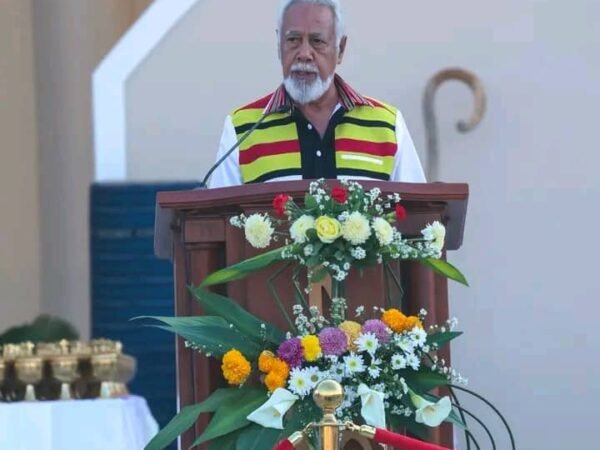
Dili, September 11, 2026 (Media Democracia) – Prime Minister (PM) Kay Rala Xanana Gusmão recognizes with great appreciation the role of the Catholic Church in the process of evangelization and also in the process of uniting the people of Timor-Leste for self-determination.
The Head of Government said that the good cooperation between the Government, the State, and the Church, which continues to this day, is also reflected in Pope Francis’s message: “Que a Vossa Fé Seja a Vossa Cultura”, (“May Your Faith Be Your Culture”).
“For all the people, sometimes people ask: Dom Martinho died there and was buried there, and why were two bishops also brought from Portugal to Timor? To talk about the first bishop of Timor, everyone thinks that Portuguese colonization started from there, and Timor became a Christian population. But it wasn’t only like that. Because at that time, children who wanted to go to school had to have a Portuguese name and had to become Christian,” said Xanana.
PM Xanana also said that in 1975, the literacy rate in Timor-Leste was still not high, because only about 28% of people knew how to read and write.
“Therefore, in 1975, only 28% of people in Timor-Leste knew how to read and write. The rest of the people still didn’t know how to read and write. This shows that the Church has been in Timor for a long time, not only through the two bishops, but also through many priests, from Portugal and from India, who came to share the Christian faith with us,” said the Prime Minister.
Xanana explained that during Portuguese colonial times, some primary and secondary schools were managed and run by the Church. Teachers were also trained in Soibada, and the Church established training centers in various areas, including Ossu, Baucau, Fuiloro, and Maliana.
According to Xanana, the Church’s great efforts in building the identity of the Timorese people cannot be separated from the history and culture of Timor-Leste.
“Thus, the history of Timor-Leste’s identity and culture cannot be spoken of separately and written separately. Tetum became an official language not because the Portuguese adopted it, but because the Church used Tetum as an important means of communication to teach catechism,” he said.
He added that nuns and priests went to various places to teach communities, and because of that Tetum also became an important language in the process of teaching faith and communication.
“Because of this, today all the priests are talking about paying tribute to the four prelates. This tribute is also for the Church’s role in evangelization and in bringing people together. Bringing people together is not only in religion,” Xanana said.
He also emphasized that during the occupation and the struggle for self-determination, the Church’s participation, especially of priests and nuns, was very strong. The Church was not only involved in social issues, but also participated directly in the war situation and the suffering of the people.
Xanana gave Dom Martinho da Costa Lopes as an example of the Church’s role in the Timorese people’s struggle. He said that many people who are now elderly, or people who were born after 2002 and are now studying and becoming educated, need to know the history of the Church’s contribution.
“That is why nuns and priests also wanted this land to achieve self-determination. In some liturgies it was said ‘No God, no culture,’ and ideas like that made some priests turn away from the idea of self-determination. But they didn’t turn away because they didn’t want to, but because they had a different understanding and way of thinking,” he explained.
He added that over time, they began to call each other, meet each other, and strengthen their relationships again, after going through conflict and division. When the struggle began, the Church’s participation also became even stronger, through priests and nuns.
Xanana also recounted the contributions of priests during the struggle. He mentioned Father João de Deus in Baucau, who at one time received a letter and left Baucau, taking Xanana himself to a safe place.
He also mentioned Portuguese priests who participated and supported the Timorese people, including Father Locatelli, Father Mário Belo, and Father Sancho.
Xanana recounted that Father Sancho was the one who took him to Ossu, at a time when they had to walk through the mountains, up and down, and face difficult situations because of hunger and threats from the enemy.
“Father Sancho said, ‘Just come,’” Xanana recalled.
He also recalled the visit of Pope John Paul II to Timor-Leste, which he considers an important moment for the world and the people to better understand the Timorese people’s struggle for self-determination.
Xanana also recalled the visit of Pope Francis to Timor-Leste, which happened two years ago. He said that the visit united all the people, to the point that many people couldn’t get into the Mass site because there were so many people.
According to Xanana, one of the Church’s roles is to unify the people through evangelization, culture, and identity. Because of that, the Timorese people pay great tribute to the Church’s contribution in creating and strengthening national culture and identity.
“That is why, in various ceremonies, today we pay great tribute to the Church’s role that created our own culture and identity. In the name of the Timorese people, we give great tribute and appreciation to the Church, because of their work from the very beginning until we achieved self-determination, being able to embrace each other, create peace, and understand one another,” he said.
He also recalled a moment when Dom Martinho da Costa Lopes and Xanana met in Mehara.
“I remember the old days, when communication was not yet easy, and a letter was given to the FALINTIL commander to meet Dom Martinho Lopes. Yes, by the grace of God and the ancestors, this sacred land,” Xanana said.
PM Xanana also recounted that in 1980, many people wanted to leave the Church and join other religions, but many people ran to the Church to register as Christians. According to him, this process continued until Timor-Leste achieved self-determination, and people began to look back at the elders who contributed to the struggle.
“Because of this, I greatly appreciate it, and in the name of the people, I give great tribute and appreciation to the Church’s role in evangelization and also during the war, because they also worked together with the people,” Xanana concluded.
Reporting: Octaviana Da Costa
Photo: Official Page MAE