
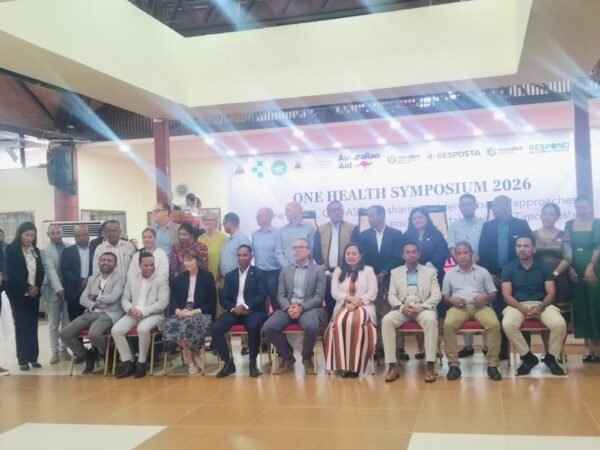
Dili, September 17, 2026 (Media Democracia) – Menzies School of Health Research Timor-Leste organized a symposium together with the Ministry of Health (MoH), the National Institute of Public Health of Timor-Leste (INSP-TL), and the Ministry of Agriculture, Livestock, Fisheries and Forestry (MAPPF), with the theme “ONE HEALTH, ONE ASEAN”, to share evidence-based approaches on human health, animal health and environmental health in Timor-Leste.
Minister of Health, Élia dos Reis Amaral, said this year’s theme, “One Health, One ASEAN”, calls for cooperation between sectors in Timor-Leste, and also for sharing research results and practical solutions with other ASEAN member states.
“One Health recognizes that human, animal, plant and environmental health are interconnected. Some diseases can be transmitted from animals to humans, and contaminated water can cause disease in humans and animals. To prevent these problems, the health, agriculture, veterinary and environmental sectors need to work together,” said Minister of Health Élia dos Reis Amaral in her speech, Thursday (17/09).
Élia said the Ministry of Health often becomes the center of public attention when health problems arise in the population.
“We recognize and accept our responsibility to protect public health, organize an effective response and continue to improve services. However, many causes come from other sectors. To resolve these causes, each responsible sector needs to fulfill its role and coordinate with other sectors,” she said.
Minister Élia also said, the Ministry of Health has started applying the One Health principle in practice, together with MAPPF and partners.
“Regarding antimicrobial resistance (AMR), the Ministry gathered various sectors in April 2026 to review the National Action Plan 2022–2026. Health, agriculture and environment institutions participated, together with Menzies and other partners. This review identified priorities for the next plan until 2030, including strengthening surveillance with laboratory support, proper use of antibiotics, infection prevention and improving access to effective medicines,” said Élia.
On this occasion, the Secretary of State for Livestock, José Veira de Araújo, said that during this time, when phenomena or problems arise in the community, many people question the available data.
“Therefore, this symposium is very important for students, researchers and technicians, because in this place we talk about data, and public policy must be based on data and a legal basis,” said Secretary of State for Livestock José Veira de Araújo.
José also said the One Health Program is important because the program comes with an integrated plan and implementation that includes a decentralization process.
Meanwhile, Deputy Director of Research at Menzies, Josh Francis, said the symposium provides space to talk about the One Health approach, which considers human health, animal health and environmental health as interrelated areas.
Josh said Menzies Timor-Leste continues to work together with the Ministry of Health and the Ministry of Agriculture, Livestock, Fisheries and Forestry (MAPPF), and Menzies’ work in Timor-Leste has been going on for a long time.
He reported that Menzies started its work in Timor-Leste during the referendum period and until now continues its activities.
“We work together with the Ministry of Health and the Ministry of Agriculture, Livestock, Fisheries and Forestry (MAPPF). We also strengthen the health system, conduct research based on national priorities and strengthen collaboration, friendship and the principle of accompaniment,” said Deputy Director of Research, Josh Francis.
He said the implementation of One Health depends heavily on accompaniment and collaboration between sectors.
“One Health means that Menzies cannot work alone. If we want to have a big impact on healthy lives in Timor-Leste, in the areas of human health, animal health and environmental health, we need to work together,” said Josh Francis.
Reporting: Octaviana Da Costa
Photo: Octaviana Da Costa