
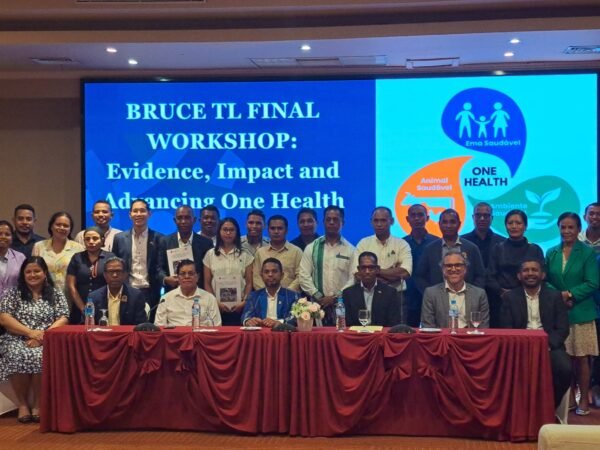
Dili, September 16, 2026 (Media Democracia) – Government, through the Ministry of Health (MoH) and the Ministry of Agriculture, Livestock, Fisheries and Forestry (MAPPF), together with partners Menzies Timor-Leste (MTL) and the Australian Centre for International Agricultural Research (ACIAR), held a workshop on the prevention and control of brucellosis in Timor-Leste.
The workshop focused on the identification, evidence and impact of brucellosis, and also on strengthening intersectoral collaboration in the health area. This activity served as an important forum to present the results and learnings from the implementation of the BRUCE-TL program.
The Vice-Minister for Institutional Strengthening of Health, José dos Reis Magno, said that this workshop presented results and evidence on the impact of the implementation of the BRUCE-TL program, which uses a co-design approach to involve stakeholders in the planning process and implementation of health activities.
“Our partners want to look for the issues that exist. Now, all ASEAN Member States are also talking about One Health. That means, when we protect our nation, we also protect other Member States. In this activity, participants discussed the learnings obtained during the program implementation, the challenges faced and the opportunities to continue strengthening the response to brucellosis in Timor-Leste,” José dos Reis Magno told journalists at Novo Turismo, Tuesday (15/09).
He said brucellosis is an infectious disease that can be transmitted from animals to humans, and its prevention requires an integrated approach between human health, animal health and the environment.
“Therefore, collaboration between government institutions, health professionals, veterinary services, communities and development partners is an important element. The evidence presented in the final workshop shows that involving stakeholders from the planning phase can help create a sense of ownership, strengthen communication and increase opportunities for sustainable collaboration in the health area,” he said.
He explained that this final workshop also gave participants the opportunity to review the program’s impact, including learning about how the co-design approach can be adapted to the local reality and support evidence-based decision-making.
“Collaboration is the key to responding to complex health challenges, including brucellosis. Co-design allows us all to learn together, plan together and seek solutions that are appropriate to the reality of Timor-Leste,” he said.
He affirmed that the results and learnings from BRUCE-TL will be the basis for continued efforts to strengthen the brucellosis prevention and control system, through an approach that involves communities and all sectors.
“With the holding of this final workshop, MS-SEP reaffirms its commitment to promote a public health response that is based on evidence, participation and intersectoral collaboration,” he said.
He said such an approach is important to ensure that health interventions are not only effective, but also sustainable and relevant to the needs of communities in Timor-Leste.
“Therefore, today Menzies together with the Secretary of State for Livestock and the Ministry of Health see that the One Health program is a priority for the Government,” he added.
The holding of this workshop shows that the response to public health and animal health challenges requires cooperation, dialogue, scientific evidence and shared responsibility.
He informed that brucellosis is an infectious disease caused by bacteria of the genus Brucella. This disease is included in the group of zoonotic diseases, meaning it can be transmitted from animals to humans.
He reported that in animals, especially cattle (bovines), brucellosis affects the reproductive system and can cause abortion, reproductive problems, infertility, retained placenta, weak offspring and decreased livestock production.
When an infected animal has an abortion, the Brucella bacteria in the placenta, fetus, secretions or other reproductive material can contaminate the environment. People can become infected when they have contact with these materials without using appropriate protection.
People can also get brucellosis through consumption of contaminated animal products, especially milk that isn’t pasteurized or not boiled, and in specific work situations, through inhalation of contaminated particles.
Thus, brucellosis isn’t just an animal disease or a veterinary problem, but also a public health problem, food safety and family livelihoods.
“In 2023, testing carried out by the National Directorate of Veterinary for 1,046 cattle in villages in the Municipalities of Bobonaro, Covalima and Oe-Cusse, identified 505 cattle positive for brucellosis. This number shows that in some areas, brucellosis can be an important problem for animal health and livestock production. However, I also want to emphasize that this data doesn’t mean that 48% of all cattle in Timor-Leste are infected. This is the result of testing in specific areas and villages in three municipalities, and needs to be interpreted according to locality, the population tested and the testing period,” he reported.
According to the evidence that already exists, brucellosis occurs in different areas and requires continuous surveillance to better understand the distribution and trend of this disease in the country.
Therefore, it is necessary to continue to carry out investigation and surveillance for human health and animal health, in order to obtain stronger evidence about the real dimension of this problem.
“The BRUCE-TL study conducted in Maliana and involving 253 cattle farmers and 22 animal health professionals, showed something very important: knowledge about brucellosis among cattle farmers is still insufficient. Only 7.5% of cattle farmers said they had heard about brucellosis in cattle, and 4% said they had heard about brucellosis in humans. But, on the other hand, this result also gives great hope. Although knowledge is still insufficient, 95.3% of participants showed willingness to use gloves when handling or contacting material from birth or abortion, and 95.7% support vaccination for their cattle against brucellosis,” he said.
He said this result is an important opportunity, because it shows that the community is ready to participate, and it is only necessary to ensure that information, resources and support systems can reach the community.
This study also identified some practices that can increase the risk of transmission.
“For example, 20.2% of livestock farmers reported that they participated in cattle slaughter; 17.4% handled or had contact with material from abortion; 5.5% reported consuming abortion material; and 6.3% consumed raw or unfermented milk.For animal management, 92.6% of households use communal grazing areas; 88% just leave the animal placenta that is born in the field; and in households that reported cases of animal abortion, 42.2% just leave materials related to abortion in the field. This data is very important because it shows that our response must look at real practices in the community, not just theory,” he explained.
He said that brucellosis in humans can start with symptoms that are often similar to other febrile illnesses. The incubation period can normally last two to four weeks, but can vary from one week to two months or more.
“Infected people can have fever, chills, heavy sweating, especially at night, fatigue and feeling weak, headache, pain in muscles and joints, loss of appetite and weight loss. Because these symptoms can be similar to other febrile illnesses, history of contact with animals, abortion material or animal products is very important for health professionals to consider brucellosis in the diagnosis. In pathophysiology, Brucella has the ability to enter the human body and can live inside cells of the immune system, especially macrophages. From there, bacteria can spread to other organs and tissues and cause inflammation and prolonged illness. This helps us understand why brucellosis can cause complications in joints, bones, liver, nervous system and, in severe cases, other organs,” he emphasized.
Therefore, early detection and appropriate treatment are very important. This reality clearly shows that human health cannot be separated from animal health and the environment.
“We can see this chain: infected animal, contaminated material, environment and food, contact or consumption, and infected person. Therefore, the response must also be complete: animal health, environment, livelihoods, food safety and human health. This is the reason why the One Health approach is very important for Timor-Leste,” he informed.
On the other hand, the Secretary of State for Livestock, José Vieira de Araújo, informed that the technical data presented at this workshop has shown an estimate of the brucellosis situation, based on research conducted by Menzies and the Government.
“The data that our technicians presented was obtained from research led by international agencies, such as Menzies, together with relevant ministries, including the Ministry of Agriculture, Livestock, Fisheries and Forestry and the Ministry of Health, which was conducted in the Municipalities of Bobonaro and Covalima,” said José Vieira de Araújo.
He said the Government has an integrated health system program, but resources are still insufficient, so it needs to work together with municipal authorities to prevent brucellosis.
“Now we have an integrated health system program, but resources are not yet enough. Therefore, we need to work together with all authorities to prevent brucellosis disease. Prevention can be through vaccination, consumption of beef that must be cooked until fully cooked, cannot be eaten raw. We also need to do socialization, dissemination and provide information in universities, communities and private sectors that raise animals in our country. We are talking especially about hygiene. There are already relevant decree-laws that the ministry has created and authorities must implement,” he said.
Likewise, Deputy Director of Research at Menzies, Josh Francis, affirmed that Menzies Timor-Leste continues to work together with the Government to combat the problem of brucellosis, through detection in humans and animals in Timor-Leste.
“I feel very proud when I come to see that people can advance priorities, do good and smart work, and do good collaboration. Because we believe Timorese people can make change and promote health through local initiatives in Timor-Leste,” said Josh Francis.
He said Menzies Timor-Leste wants to continue to support awareness campaigns and leadership, through projects that can provide assistance in the area of human and animal health.
“We want to support awareness campaigns for leadership and projects that can provide assistance on the health situation, together with partners, based on national priorities and strengthening effective collaboration. I really prefer that this BRUCE-TL project becomes a good example for other health projects in Timor-Leste,” he said.
He said that this activity also provided an opportunity to hear about BRUCE-TL, including updates from technicians about the project carried out in the municipalities.
“The success of this project depends on collaboration and leadership from the community. Thanks to the authorities from the Municipality of Bobonaro, because you came from the community and gave us the opportunity to hear and work together with the community. Thanks also to the Secretary of State for Livestock and Fisheries and the Vice-Minister of Health for Institutional Strengthening of Health. I believe this will be a good example for other countries. Collaboration and principles in health can have a big impact and contribute to the nation. I am also proud of the Menzies team because I can see that we understand principles and priorities, work together and do good things for our nation, especially to ensure better health for everyone in Timor-Leste,” he concluded.
Meanwhile, this workshop was attended by representatives of line ministries, the Bobonaro Municipal Authority, technicians from the Ministry of Health, the Ministry of Agriculture, Livestock, Fisheries and Forestry, and the Menzies Timor-Leste team.
Journalist: Octaviana Da Costa
Photo: Octaviana Da Costa